The Wrong Kind of Winter
Climate, Economy

The Wrong Kind of Winter

Apr 25, 2026

What this fall’s super El Niño could mean for New England and Eastern Canada—a season where everything costs more to fix

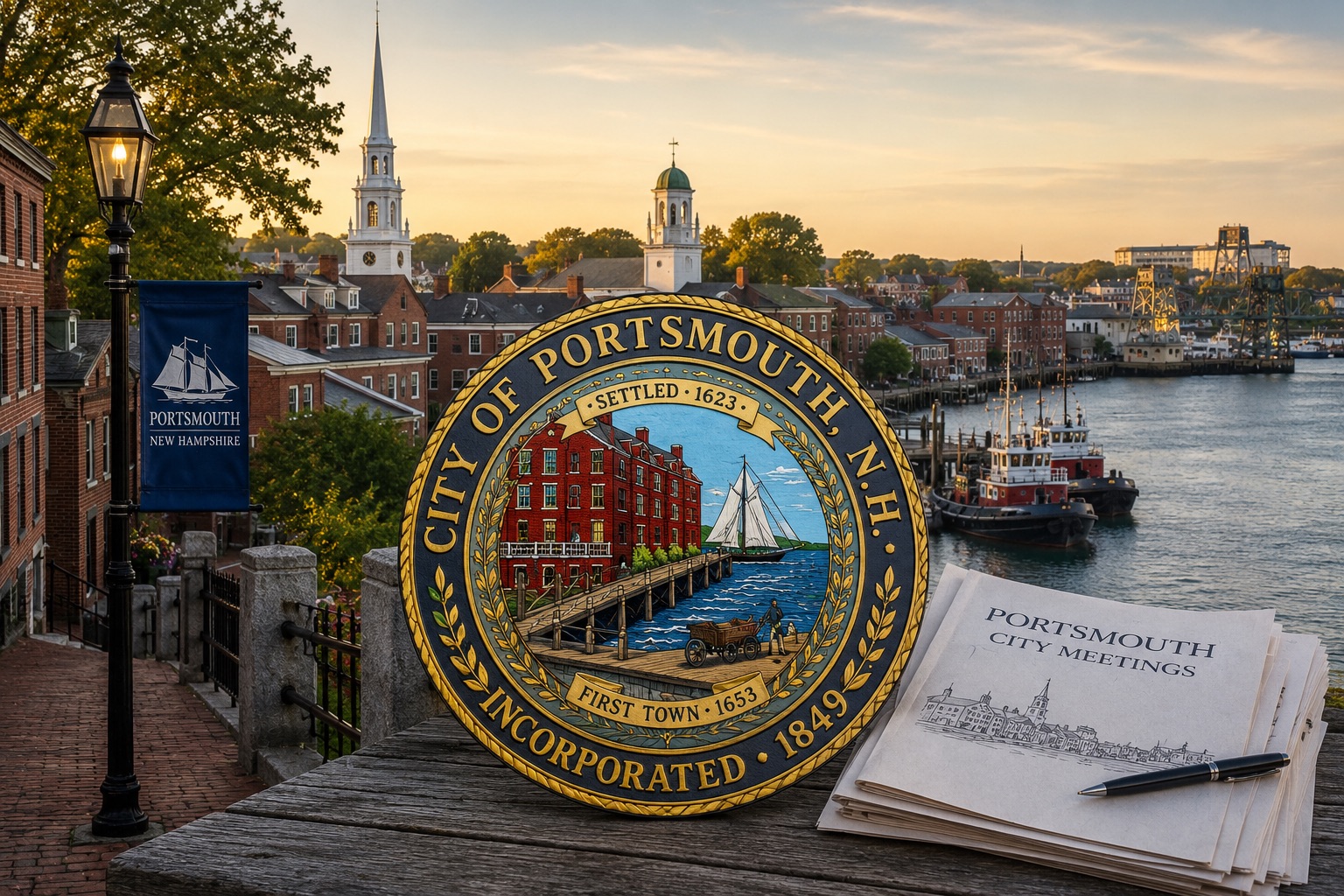
The tide doesn’t have to roar into Portsmouth to make its point.

Some mornings it just arrives a little too high, stays a little too long, and pushes through a piece of infrastructure that was built for a different version of winter. A storm drain that used to empty into the Piscataqua reverses direction. Water comes up instead of going down. It spreads across the street, finds the low spots, and holds there longer than it should.

No one calls it a disaster. Not yet.

A few blocks get wet. A basement takes on water. Public works adds another item to a list that never quite clears. By afternoon the tide falls back, the street dries, and the town returns to normal, which is to say, it absorbs the cost and moves on.

That’s how this story works here. It doesn’t announce itself. It repeats itself.

Nothing fails all at once. It just keeps costing more to live the same way.

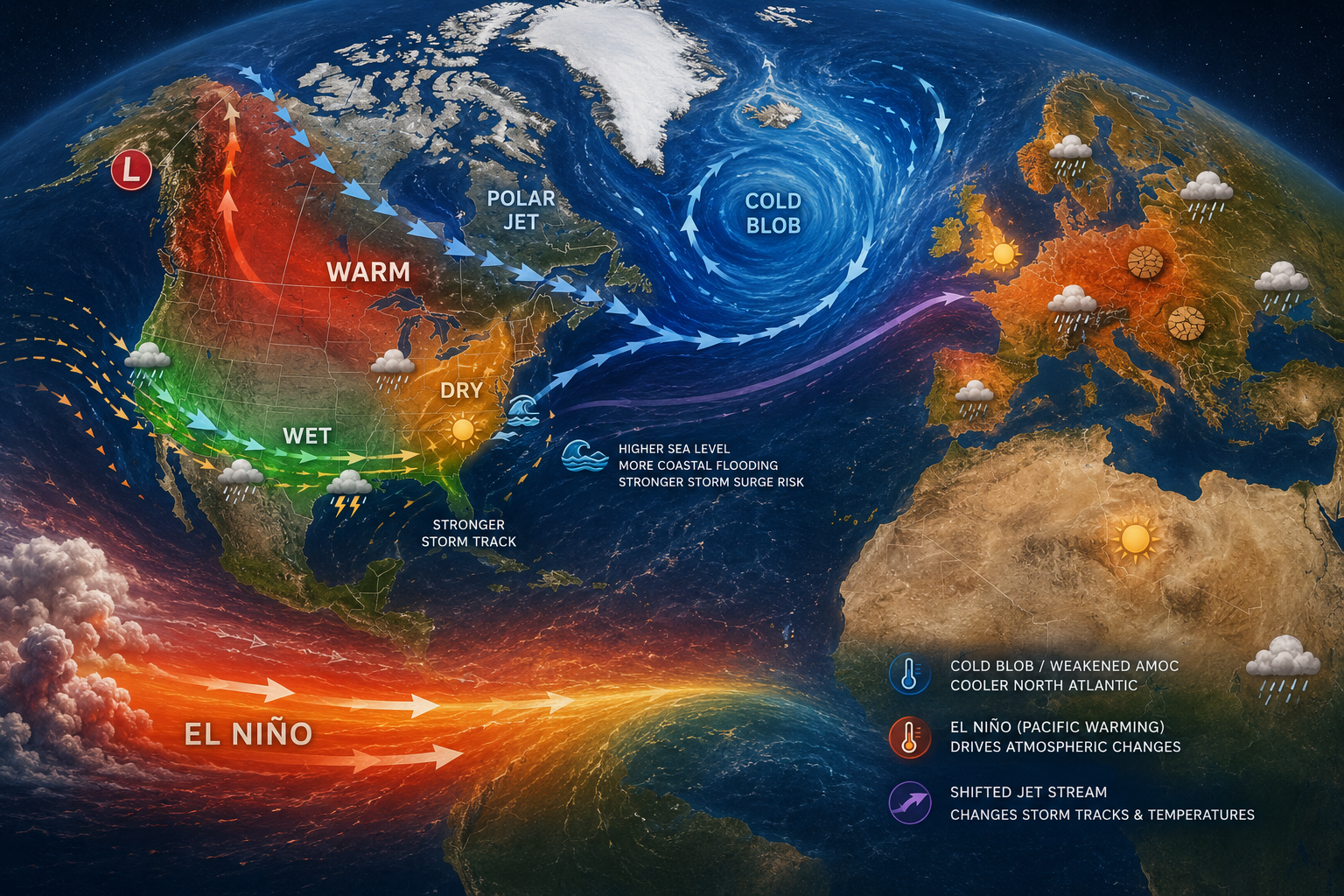
Out in the Pacific, the setup is taking shape. The trade winds weaken, the warm pool that normally sits piled up in the western Pacific begins to slide east, and heat stored in the ocean is released into the atmosphere. That shift reorganizes the jet stream—strengthening the southern branch, loosening the grip of Arctic air over the northern tier, and redirecting where storms draw their energy and moisture.¹²

El Niño is part of the system. It always has been.

What matters now is where it lands.

The background climate has already moved. The ocean is warmer than it was during the last major El Niño events. The atmosphere is holding more moisture. When the Pacific releases heat into circulation, it isn’t adding variability to a stable system. It’s amplifying one that is already carrying more energy than it used to.³

That difference shows up in small ways first.

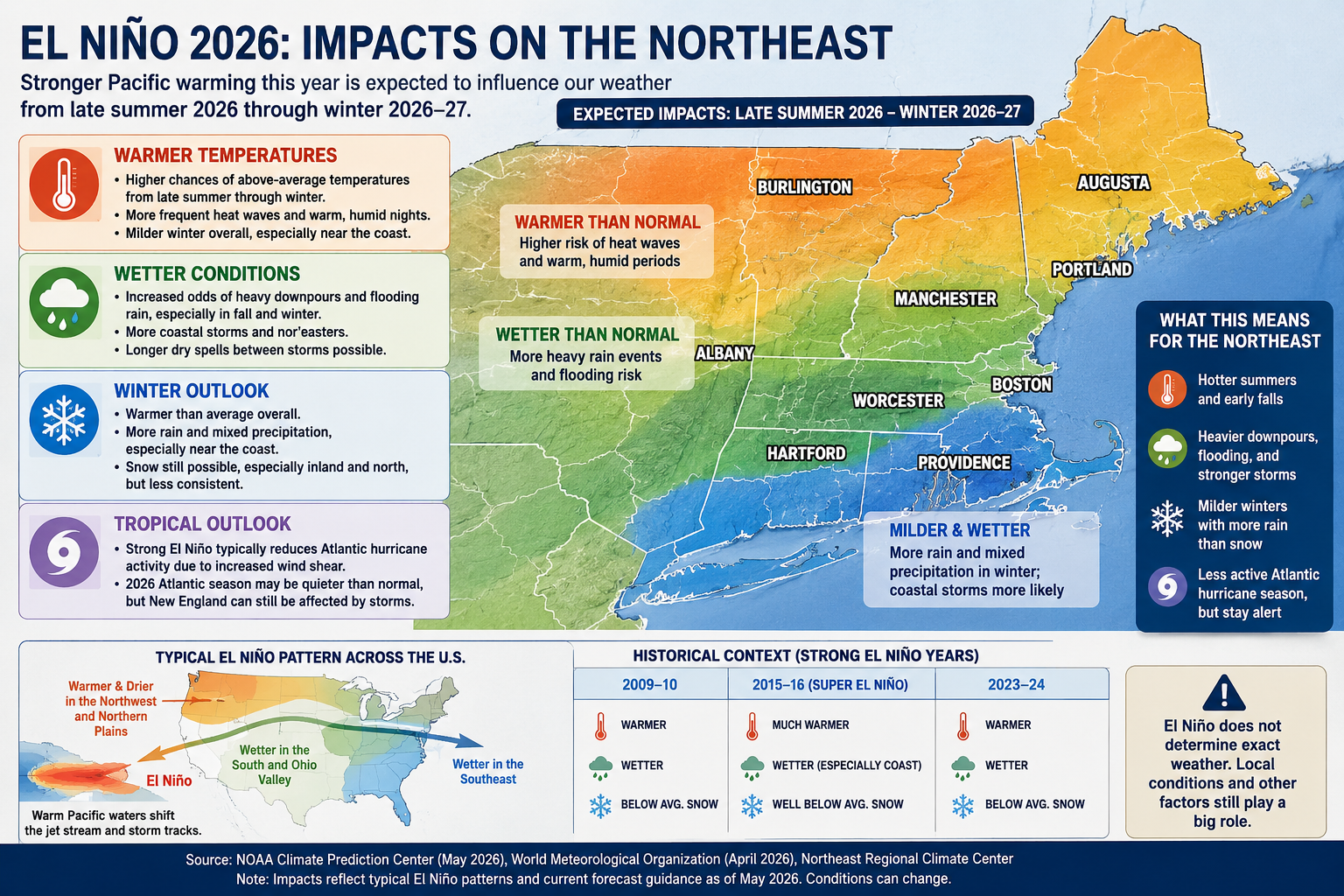
In New England, winter still arrives. It just arrives unevenly.

Cold comes, but it doesn’t always hold. Snow falls, but it doesn’t always stay. A storm drops a foot, then another follows with rain that cuts through it. The ground freezes, thaws, and refreezes until the surface starts to fail. The snow that does fall carries more water and does more damage when it comes down.

It is still the same winter people recognize. It just behaves less predictably inside its own boundaries.

The pressure shows up in how tightly systems have to operate.

Skiing is a capital problem now. Snow can be manufactured, but only inside a narrowing temperature window. When that window closes—even briefly—the investment disappears and has to be rebuilt.

Maple production is a timing problem. It depends on a narrow rhythm—freezing nights, thawing days. When winter drifts warm, that rhythm breaks. The season still happens, but not reliably.

Municipal systems absorb what neither can control. Rain on snow moves water faster than drainage was designed to handle. Freeze–thaw cycles degrade roads faster than they can be repaired. Heavy, wet snow does more damage than powder ever did.

The pattern is familiar. What changes is how often it repeats.

In Boston, high-tide flooding events have increased more than fivefold since the 1950s.⁴ Insurance markets have already adjusted. In parts of coastal New England, homeowners have seen premiums rise by 20 to 30 percent in recent years—or lost coverage entirely—as risk is repriced.⁵

Farther north, in Portland and Portsmouth, the same pattern plays out at smaller scale: more water, more often, moving through systems built for less of both.

The ocean is part of that shift. The Gulf of Maine has been warming faster than most ocean regions on Earth—at times roughly three times the global average.⁶ That warmth feeds coastal storms and narrows the margin between routine weather and damaging events.

Across Canada, that margin narrows further.

In Halifax and across Prince Edward Island and Newfoundland, sea ice once absorbed winter storm energy before it reached the coast. When that ice forms later, or not at all, storms meet open water instead, building wave energy over longer distances and delivering it directly to shore.⁷

Inland, in Quebec, the same shift changes the timing of water itself. Hydropower systems depend on predictable accumulation and release—snowpack building through winter and melting steadily in spring. When more precipitation arrives as rain, runoff comes earlier and faster, forcing operators to manage variability instead of seasonality.⁸

New England depends in part on that system, and in January 2026 a Hydro-Québec transmission line stopped exporting electricity for roughly two days during a cold snap as Quebec prioritized domestic demand. The U.S. Energy Information Administration described the interruption as a stress test for the region’s winter energy system.⁹

A flooded street is a public works issue. Repeated flooding becomes an insurance issue. Repeated losses and rising repair costs begin to affect how a town borrows.

Moody’s and other rating agencies have begun incorporating climate exposure into municipal credit assessments, noting that repeated infrastructure damage and rising insurance costs can weaken local fiscal positions and, in some cases, contribute to negative outlooks or higher borrowing costs over time.¹²

The Pacific shifts. The storm track follows. Water moves differently. The cost shows up somewhere else—in a premium notice, a bond discussion, or a utility bill.

Which brings the story back to policy, and to the one place where the United States still has leverage before damage becomes debt.

The Federal Emergency Management Agency is built to respond to disasters, but just as importantly, to reduce them before they happen. Programs like BRIC—Building Resilient Infrastructure and Communities—fund drainage upgrades, flood protection, electrical hardening, relocations from hazard zones, and the unglamorous work that prevents small failures from becoming larger ones.

In 2025, that program was canceled. In 2026, a federal court forced its reinstatement, restoring roughly $1 billion in mitigation funding after billions in projects had been frozen or delayed.¹⁰

The interruption matters more than the headline.

Projects delayed are not neutral. A culvert not upgraded this year fails under next winter’s runoff. A drainage system left undersized becomes a recurring problem instead of a solved one. The cost doesn’t vanish during the pause; it compounds into the next season.

At the same time, staffing reductions—thousands of FEMA departures over the past year—have raised concerns about response capacity, not for a single catastrophic event but for the accumulation of smaller ones that require coordination, reimbursement, and follow-through.¹¹

The vulnerability isn’t failure. It’s strain—more things bending at once, more often, for longer.

A strong El Niño would not create that condition. It would align it—bringing a warmer ocean, heavier moisture, storm tracks that lean toward the East Coast, and winter patterns that are less stable than the systems beneath them were designed to handle.

The Pacific is where the signal begins, but it does not stay there. It moves through the jet stream, into the storms, into the snow that does not quite hold and the rain that arrives at the wrong time, into the water that moves faster than the drains can take it and the coastlines that take the hit without the buffer they once had.

By the time it reaches New England, it no longer looks like a climate event. It looks like a series of ordinary problems arriving out of sequence—wet snow on power lines, water backing through a drain, a repair that costs more than the last one, a budget that stretches a little further to cover it.

Most of it will be fixed. It usually is. The street dries, the slope turns green, the culvert gets replaced, and the next storm arrives on a system that is slightly more worn and slightly more expensive to maintain.

Nothing collapses. The town holds. The region holds.

But it does so on different terms than it used to, with less margin, more cost, and fewer places for the stress to go.

And when the next season begins, it doesn’t begin from where it once did, but from wherever the last one left it—carrying forward the damage, the repairs, and the quiet adjustments that have already been made.

Bibliography

Moody’s Investors Service — Climate risk in municipal credit assessments, 2024–2025.

Nuclear to Mars
Tech, Climate

Nuclear to Mars

Apr 24, 2026

NASA’s shift from explosive thrust to continuous power—and what it makes possible

The checklist sits on a second monitor, half-hidden behind a telemetry window, while Alvarez leans back just far enough to see both without moving his chair. He came over from propulsion analysis five years ago, after a launch scrub that turned on a valve fault no one had modeled correctly, and he still keeps that report in a folder he doesn’t open. The spacecraft is already two days out, coasting on the last chemical burn, and the line he’s watching for is unremarkable: reactor enable, conditional.

He doesn’t say anything when it clears. He marks the time, then waits through the lag that always follows commands sent across that distance, long enough for doubt to creep in before the data returns and settles where it should.

“You don’t celebrate this step,” he says later. “You verify it, because if it’s wrong, you won’t get a second try.”

What changes in that moment doesn’t register as a spike or a surge. It shows up as continuity. Heat where there was none, electrical load that doesn’t decay, a thrust profile that begins and does not end. The spacecraft stops behaving like something that was thrown and starts behaving like something that works.

Call it a small thing—the difference between a push and a process—but it changes what the rest of the mission is allowed to become.

Alvarez learned his instincts on chemical systems, where propulsion is a short, decisive conversation with physics. You burn propellant, you get your delta-v, and then the system goes quiet, leaving guidance and small corrections to carry you the rest of the way. It is elegant and brutally constrained at the same time. You can reach a destination with precision, but you arrive with whatever you managed to pack at the beginning, no more and no less.

“We got very good at leaving,” he says, glancing back at a trajectory plot that is already obsolete. “Staying is a different problem.”

The reactor changes that problem by changing what the spacecraft does with time. Instead of converting fuel directly into thrust, the system converts heat into electricity and electricity into motion, feeding a set of thrusters that produce almost no force at any given instant. The force is slight enough to vanish into rounding errors over short intervals, which is why the curve the navigation team watches looks almost flat until it doesn’t.

A specialist on that team keeps a printout pinned to the edge of her console, the kind of chart that invites skepticism because it looks too gentle to matter. “It’s not acceleration the way people think of it,” she says, running a finger along a line that bends upward by degrees. “It’s accumulation. Leave it alone long enough, and it outruns what you expect.”

That curve shows up early in the mission design, shaping everything that follows. Once you commit to sustained low thrust, you commit to a different allocation of mass and risk. You carry less propellant, because you don’t need to spend it all at once, and you carry more capability, because the system that produces your motion also produces your power. The spacecraft becomes less like a projectile and more like a platform.

The first consequence is physical. If you are not devoting most of your mass to propellant, you have room for payloads that do more than observe and transmit. In NASA’s case, that includes helicopter scouts for Mars, small enough to travel as secondary cargo but capable of mapping terrain, identifying landing zones, and probing for subsurface water once they arrive.

The second consequence is temporal. A reactor that produces steady electrical output does not care whether the Sun is available, whether dust is in the air, or whether the environment aligns with your operating window. On the Moon, where night lasts roughly two weeks, solar systems shut down or rely on storage that adds mass and complexity. On Mars, dust storms can reduce solar output to a fraction of nominal levels for extended periods. A reactor continues.

“Power is what lets you make commitments,” an engineer working on surface systems says. “Without it, everything is provisional.”

The propulsion work feeds directly into the question of sustained presence. If you can launch, start, and operate a compact reactor in deep space, you have demonstrated a power system that can be set down on a surface and left to run through conditions that defeat alternatives.

In Idaho, where teams are developing what the Department of Energy classifies as microreactors, the target is not a city but a constraint. Diesel fuel that has to be shipped in over long distances, at costs that can exceed three hundred dollars per megawatt-hour in remote locations, defines the operating limits of entire communities and industrial sites. Replace that with a compact reactor that can run continuously for years, and the constraint changes character.

A project manager there, standing beside a mockup that occupies less space than most people expect, frames it in terms that echo the space program without trying to. “We’re trying to make nuclear behave like equipment,” she says, tapping the side of the unit. “Something you deliver, install, and depend on.”

Current designs aim for outputs in the range of a few to tens of megawatts electric, with refueling intervals measured in years and footprints small enough to be transported in modular sections. They do not replace centralized generation, but they change the arithmetic wherever the alternative is a fuel chain that can be interrupted, delayed, or priced beyond what the site can absorb.

In space, reactors are being scaled to the smallest viable systems that can support propulsion and survival beyond Earth orbit. On Earth, they are being scaled to the smallest viable systems that can be deployed where centralized infrastructure does not reach.

That is where the conversation turns, almost inevitably, to fusion.

A physicist who has spent much of her career on confinement systems answers the question without embellishment. “First you get a plasma that sustains itself,” she says. “Then you get net power. Then you get materials that survive. After that, you can talk about form.”

The order matters. Controlled reactions have been demonstrated, but continuous, economically viable operation requires maintaining extreme temperatures, sufficient particle density, and confinement long enough to produce more energy than is consumed, all while managing neutron flux that degrades structural materials and complicates fuel cycles. Each requirement is a boundary condition. Together, they define a system that has yet to stabilize.

Even if those hurdles are cleared, the path to smaller systems introduces its own constraints. Shielding does not shrink without consequence. Fuel handling imposes additional requirements. Thermal management becomes more difficult as systems compact.

“We’re still proving the plant,” she says. “Portability is a different conversation.”

NASA is not ignoring fusion. It is building with what can be engineered, tested, and flown within a timeframe that intersects with policy, budgets, and mission windows. Fission offers that path, along with a set of challenges that are understood well enough to manage, if not eliminate.

Those challenges introduce tension that does not show up in the clean lines of a trajectory plot. Launching a reactor requires approvals that extend beyond engineering into regulatory review and public scrutiny that have historically slowed or stopped similar efforts. Cost projections still compete within a budget environment that shifts with political cycles. Integration risks remain, particularly when adapting hardware originally designed for different roles.

None of that is visible in the data Alvarez watches.

By the time he closes his console, the numbers have settled into a pattern that no longer surprises him. The power draw is stable. The thrust profile matches the model within tolerances that would have been questioned a decade earlier.

He lingers a moment longer than he needs to, watching a line that moves slowly enough to resist interpretation, aware that its significance lies in what it will look like weeks from now rather than in what it shows tonight.

“This is the part that matters,” he says. “The part where it doesn’t stop.”

Outside, nothing marks the change. No light, no sound, nothing that would suggest a system has shifted from impulse to duration. Far beyond that horizon, a machine is still adding to its velocity, one quiet increment at a time.

Bibliography

Local, Climate

The End of the Parking Lot Dividend

Mar 26, 2026

How Portsmouth, New Hampshire, is replacing retail with housing—and why Newington isn’t sure it can

The chain-link fence went up on a damp morning off Durgin Lane, the kind of coastal gray that flattens everything into a single tone until you notice the details—a forklift idling, a worker dragging plywood across the old entrance of the Bed Bath & Beyond, the faint geometry of parking lines that still pointed toward doors that no longer existed.

A man in a heavy winter jacket stopped near the curb, looked across the empty lot where the Christmas Tree Shops and Bed, Bath, and Beyond had been, and said to no one in particular, “That place paid for a lot more than what they sold.”

It did, though not in a way most people ever saw.

The loss of retail doesn’t just remove a store. It removes one of the most efficient components in a municipal tax system—an asset that generates high revenue while placing relatively limited sustained demand on services—and replaces it with something that may be more valuable on paper but behaves differently once people begin to live inside it.

That shift is what Portsmouth is now working through on this site, and what Newington is still negotiating around at Fox Run Mall.

The difference isn’t philosophical. It’s structural.

In New Hampshire, property taxes don’t distinguish between residential and commercial rates. A dollar of assessed value is taxed the same way whether it comes from an apartment or a retail box, which gives the system a kind of surface simplicity that disappears the moment you account for what each type of property requires in return.⁵

Retail concentrates value.

A big-box store sits on a large parcel, produces a high assessed value, and generates steady tax revenue without sending children into the school system and while placing relatively limited sustained demand on municipal services. Police calls occur, maintenance is required, but the baseline cost profile remains low relative to the revenue produced.

A former Portsmouth assessor, speaking in what he described as a common shorthand used in municipal finance discussions, put it this way: “Commercial property pays for services it doesn’t use. Residential uses services it doesn’t fully pay for.”

That formulation isn’t a law, but it captures the direction of the imbalance seen in municipal finance studies across the country.⁷

In its later years, the Durgin Lane retail site was assessed in the range of roughly $25–35 million, according to city property records, generating on the order of $400,000 to $600,000 annually in property taxes depending on the assessment cycle.¹² It did so with minimal ongoing service demand, functioning as a quiet surplus contributor within the city’s budget.

What replaces it—Prescott Post—is financed at nearly $100 million and will likely be assessed somewhere near that level once stabilized, which pushes annual tax revenue closer to $1.5–$2 million under Portsmouth’s combined tax rate.³

On paper, that looks like a clear upgrade.

The complication arrives with the people.

Residential property doesn’t just contribute revenue; it introduces recurring demand that scales with occupancy—public safety calls, infrastructure use, and, most significantly, education costs tied to school enrollment. The impact varies sharply depending on the type of housing, which is where multifamily projects like Prescott Post behave differently from suburban subdivisions.

Apartments compress both value and cost.

Units are smaller, infrastructure is shared, and the number of school-aged children per unit is typically low. Portsmouth planning assumptions for comparable multifamily developments have used working estimates of roughly 0.1 to 0.2 school-aged children per unit, a fraction of what single-family housing generates, which keeps the added school burden within a range that can be offset by higher assessed value.⁴

A city councilor, speaking during a housing discussion last year, framed the tradeoff more cautiously: “Apartments don’t come free. But if the valuation is high enough and the student count stays low, they can carry themselves.”

That conditional is doing real work.

Portsmouth approved the Durgin Lane redevelopment without offering a large tax concession because the underlying math, while not frictionless, is strong enough to support private financing. The project secured nearly $100 million in construction funding without requiring the city to redirect future tax revenue back into the development, preserving municipal control over the full tax base once the buildings are complete.³

A few miles away, the same confidence doesn’t exist.

At Fox Run Mall, the redevelopment proposal has leaned on a tax increment financing structure that would allow the developer to retain a significant share of future tax growth to pay for infrastructure. The request signals a different set of conditions: a declining asset, higher redevelopment costs, and a use mix that may not reproduce the combination of valuation and relatively low service demand that retail once provided.⁶

A Newington official, speaking during a recent discussion of the project, captured the hesitation: “We can’t assume the replacement will behave like the mall did. It probably won’t.”

That uncertainty is the hinge between the two towns.

Portsmouth is replacing underperforming retail with high-demand housing in a market where rents, occupancy, and financing all support the transition. The city is not betting that housing is more efficient than retail; it is accepting a shift from a surplus-generating land use to one that is closer to balance, where revenue and service demand rise together and must be managed in tandem.

Newington is facing a harder problem.

The mall, even diminished, represented a form of land use that concentrated tax revenue while keeping municipal costs comparatively low. Replacing it means moving into a more complex fiscal structure where the margin between what a property contributes and what it requires becomes narrower and less predictable.

The asphalt at Durgin Lane is mostly gone now, broken into sections where foundations will be poured, and the site has begun to shift from a place people passed through to a place where they will stay.

What used to be a parcel that generated several hundred thousand dollars annually while drawing little from the system is becoming one that may generate closer to two million dollars while also introducing a steady stream of service demand tied to hundreds of residents.

That is the trade, expressed in concrete terms.

The land will likely produce more revenue than it did at the end of its retail life, but it will no longer function as a quiet surplus inside the city’s budget. It will operate closer to equilibrium, where value and cost move together, and where the fiscal stability of the system depends less on isolated high-yield parcels and more on the aggregate behavior of the people who live there.

The parking lot is gone.

In its place is something that carries its weight differently.

Bibliography

1. City of Portsmouth, NH – Property Assessment Records. Municipal valuation data for Durgin Lane retail parcels used to estimate prior assessed value and tax contribution.

2. Rockingham County Registry of Deeds – Parcel Records (Portsmouth, NH). Public land and ownership records supporting valuation range and site history.

3. Boston Real Estate Times – “$96.8 Million Secured for 360-Unit Apartment Project in Portsmouth, NH.” Reporting on financing and scale of Prescott Post development.

4. City of Portsmouth Planning Board Documents – Multifamily Development Reviews. Includes planning assumptions on school-age children per unit (approx. 0.1–0.2 range).

5. New Hampshire Department of Revenue Administration – Municipal Tax Rate Structure. Documentation confirming single-rate property tax system across property classes.

6. Town of Newington, NH – Public Meeting Minutes (Fox Run Mall Redevelopment). Discussions of proposed Tax Increment Financing (TIF) and redevelopment uncertainties.

7. Lincoln Institute of Land Policy – “Cost of Community Services Studies.” Research showing typical fiscal patterns of residential vs. commercial land use and service demand.

8. American Planning Association – Fiscal Impact Analysis Resources. Frameworks for evaluating municipal revenue versus service cost across land-use types.

Economy, Climate

The New Math of Dinner

Mar 23, 2026

The counter at my local fish market on the seacoast has become a place where people pause.

Chilean sea bass sits at thirty-eight dollars a pound. Salmon beside it reads nineteen ninety-nine—still reasonable, but no longer casual. No one says anything. The man behind the counter keeps wrapping fillets in white paper. “People are still buying,” he said, not looking up, “just not the same fish.” Customers linger a few seconds longer, doing quiet arithmetic.

You don’t need a pound. A third of a pound per person puts dinner for two near fifty dollars before anything else touches the plate. That’s enough to change how the decision feels. Your eyes move a few inches down the ice. Salmon becomes a consideration. Hake appears at five seventy-nine. Same pan, same time, same act of cooking—one costs nearly seven times the other.

“Nothing disappears. It just moves.”

Food prices don’t move as one thing anymore. Groceries break apart the same way—beef, sweets, and coffee climbing, eggs falling, other staples barely moving.² Restaurant meals follow a different path, with full-service places climbing faster still.¹

The center of the meal has held. Chicken, rice, pasta, potatoes still feel familiar. It’s the range that’s shifted. The high prices are higher, and the lows are the same.

Beef climbed first. The U.S. Bureau of Labor Statistics says the average price for steaks across the country is $12.74 per pound. I don’t believe it—and neither does anyone standing at the counter.¹ Tenderloin pushes past forty. Chicken sits closer to $4. The gap isn’t imagined. It’s structural.

Seafood followed—fuel, quotas, and a fishery system under stress. Warming waters are pushing species northward or deeper, changing where and when fishermen can catch them. The shifts, as NOAA puts it, “can also cause economic disruptions.”⁴

The result is a food economy that no longer moves together—some things go straight into the cart, some make you pause, and some you leave behind.

You can see it in how decisions get made. Some people still choose without thinking. Others pause, look, adjust. For some, it’s still a quick decision. For others, it’s a calculation.

What had been a smooth set of choices breaks apart, and once that happens, people move between them. Not out of the system, but within it. Purdue found that 82 percent of shoppers changed how they buy food—seeking discounts, switching brands, cutting nonessentials.⁵

You see it first in the meals you no longer make automatically. Carbonara used to be one of those—bucatini, egg yolks, Pecorino, Parmigiano, a little slab bacon. Now the cheese alone makes you pause. What once felt like pantry food reads like a list.

So you make something else.

For example, “poulet chasseur” is just a fancy French name for a simple choice: chicken thighs seared in a skillet with mushrooms, shallots, a good pour of white wine, and diced tomatoes. Let it simmer for twenty minutes, and dinner’s ready. Light a candle, fill the glasses, and you have a meal for two that feels like an evening out—for well under twenty dollars.

Chicken has become the quiet center of gravity. Everything around it has moved higher, and the decision shifts from whether to buy to how to use.

The same thing happens at the counter. You don’t stop buying fish; you reach differently. Sea bass fades. Salmon becomes situational. Hake, steelhead, shrimp when the price holds—they take its place.

And then something more subtle happens.

You begin to read the price tags.

Faroe Islands salmon is a few dollars less, and it looks just as good. Steelhead gives a lighter, firmer touch for less money. Price and category don’t quite line up anymore. It might be time to try the $14 Cajun catfish.

You start choosing differently.

Convenience used to be the restaurant trip—eat there or take it home. Now restaurant prices are rising faster than groceries, and you notice it. Most restaurants report higher food costs; many are cutting menu items, shrinking portions, or quietly swapping ingredients—chicken where fish used to be, smaller cuts where larger ones once held the plate.³ Success now hinges on getting the math right.

Even so, an evening out for two can easily push past $150—and in cities like New York or Seattle, $200 isn’t hard to reach. Add a couple of glasses of wine, tax, and tip, and you’re suddenly pushing $300.

At home, the calculation resolves differently. A skillet, a little oil, something that browns, something green, something that absorbs what’s left—dinner comes together quickly and often tastes better.

Rice and potatoes stop being filler and start being deliberate. Tomatoes get bought in season and frozen, shifting cost across time instead of eliminating it. You can make a gallon of Greek gigante bean soup for under $10—and it tastes like more than it costs.

It doesn’t feel like a step down. It feels like noticing what was always there.

Meals that once felt routine begin to feel chosen. Things that used to be automatic become occasional, then intentional. The line between everyday and special shifts a little, almost without notice. You still eat well, you still sit down at the same table, but the ease that once surrounded those decisions—the sense that you could choose without thinking—gives way to something quieter, more aware.

You learn what things cost. You learn what works. And once you do, the old habits don’t quite fit the same way. The same shift is happening everywhere—menus tightening, substitutions becoming standard, the distance between everyday and special stretching a little wider.

It comes together in the pan, then on the table. It’s still dinner—but now it’s better, cheaper, healthier—and you made it that way.

Bibliography

1. U.S. Bureau of Labor Statistics. “Average Retail Food and Energy Prices, U.S. City Average.”

2. U.S. Department of Agriculture, Economic Research Service. “Food Price Outlook, 2026.”

3. National Restaurant Association. “2026 State of the Restaurant Industry Report.”

4. National Oceanic and Atmospheric Administration (NOAA). “Understanding Our Changing Climate.”

5. Purdue University. “Consumer Food Insights Report, December 2025.”

Meatball Talks
Economy, Climate

Meatball Talks

Mar 18, 2026

The refrigerated truck idled at the loading dock while the driver checked his clipboard.

It was a poultry rig—the kind that moves cages of chickens from farms to processing plants across New England before dawn. The air carried the dull smell of feed dust and feathers, and the metal sides of the trailer ticked faintly as the compressor kept the interior cold. Workers were sliding cages toward the back when another crate was loaded among them.

According to a man who later spoke with federal investigators, that crate contained a Rembrandt.

For a short stretch of road, perhaps only a few hours, one of the most famous missing paintings in the world may have been traveling through New England in the back of a chicken truck.

The image surfaced years later through Geoffrey Kelly, an FBI agent who spent more than two decades working the Isabella Stewart Gardner Museum theft. Kelly spent much of that time chasing fragments—tips that collapsed, informants who changed their stories, rumors that evaporated as soon as agents reached the warehouse or apartment where the paintings were supposed to be.¹

The chicken truck was one of those fragments.

It stuck with him.

The Gardner robbery itself now feels almost simple.

Shortly after midnight on March 18, 1990, two men dressed as Boston police officers arrived at the museum and told the night guard they were responding to a disturbance call. Once inside, they restrained the guards and spent eighty-one minutes moving through the galleries.²

The duration is one of the oddest details of the crime.

Most art thefts happen in minutes. The Gardner thieves stayed long enough to walk calmly from room to room deciding what to take. At one point they even made a second pass through a gallery before leaving.

When they finally walked out, thirteen works of art were gone.

Among them were Rembrandt’s The Storm on the Sea of Galilee—the only seascape he ever painted—and Vermeer’s The Concert, one of fewer than forty surviving works by the Dutch master. Degas drawings, a Manet painting, and several smaller pieces disappeared as well. Today the missing works are collectively valued at roughly half a billion dollars.³

The choices the thieves made that night still puzzle investigators. Several canvases were cut roughly from their frames while more valuable works hanging nearby were ignored entirely.

The selection suggests the thieves were not acting like art historians.

They were choosing names.

Rembrandt.

Vermeer.

Degas.

Those names carry weight well beyond the art world. A criminal who controls something recognizable and irreplaceable controls a bargaining chip. The more famous the object, the greater the pressure it creates.

For years investigators struggled with a basic contradiction. Paintings of that stature are among the most valuable objects on earth, yet once they were stolen they became almost impossible to sell. The legitimate art market depends on provenance—the documented chain of ownership that allows a painting to be insured, exhibited, and traded. Once a work is stolen and publicly identified, that chain breaks permanently. Museums cannot display it. Auction houses will not list it. Even private collectors cannot insure it without inviting law enforcement scrutiny.

The Gardner paintings therefore became a strange category of object: culturally priceless, commercially unusable.

At first investigators assumed the thieves intended to sell the paintings quietly to a secret collector. Over time that explanation became harder to sustain. The Gardner works were simply too famous. Anyone attempting to display them would instantly expose the crime.

Inside the investigation a different explanation gradually took shape.

In the criminal economy, objects do not have to be sellable to be valuable.

They only have to create pressure.

A stolen Rembrandt carries enormous reputational weight even among people who know almost nothing about art. The name alone signals rarity and importance. For a criminal organization, possessing something that famous can function as collateral in negotiations—something that can be offered when seeking leniency, settling debts, or bargaining for advantage in disputes.

The paintings stopped behaving like artworks the moment they left the museum.

They began behaving like hostages.

In organized crime, leverage often circulates through rumor as much as possession. A crew does not necessarily have to display the asset; it only needs to convince others that it controls it. A painting that cannot be sold can still influence negotiations—appearing quietly during plea discussions, surfacing in whispers during disputes between rival groups, or reappearing when someone needs bargaining power with prosecutors.

For years federal agents believed the Gardner works circulated in exactly that way.

Not hanging on walls.

But appearing briefly when someone needed leverage.

One of the most unusual sources investigators spoke with was a Boston criminal named Ronnie Bowes. In underworld circles he was known simply as “Meatball,” a nickname that sounded almost comic until you looked at the charges attached to his name.

Bowes was a thickset man with a shaved head and a heavy Boston accent that flattened vowels into gravel. People who dealt with him often remembered the way he leaned forward when he talked, as if delivering information that might turn dangerous if repeated too loudly. He eventually went to prison for his role in a triple murder tied to a drug deal, but before that he had moved through the same neighborhoods, bars, and trucking routes that investigators suspected the paintings had passed through.

When Bowes talked, investigators listened carefully—not because he was trustworthy, but because he understood the infrastructure of the local criminal economy. He knew who controlled which warehouses, which trucking companies looked the other way, which crews used storage lockers instead of safe houses.

According to accounts of his conversations with investigators, Bowes described moments when the Gardner paintings surfaced briefly inside that world. Not as objects hanging on walls, but as things mentioned in quiet conversations—proof that someone, somewhere, still controlled them.

The world he described had little resemblance to the romantic mythology of stolen art. The paintings did not move through elegant private collections. They moved through the everyday logistics infrastructure of the Northeast—warehouses along industrial roads, rented storage units, trucking depots where cargo passed quietly from one vehicle to another.

The routes he described were the same ones used for ordinary commerce: refrigerated trucks leaving food depots before dawn, trailers heading south on Interstate 95, buildings where forklifts moved crates that no one bothered to inspect closely.

In that environment a poultry truck would not attract attention.

It would look exactly like everything else.

Bowes hinted at exactly that dynamic. In his telling, the paintings were less like loot and more like insurance policies—assets that could be invoked when someone needed bargaining power. Whether he ever saw the works himself was never entirely clear. In investigations like this, the line between witness and rumor is rarely sharp.

But Bowes understood something investigators were slowly realizing as well: inside the criminal economy, the most valuable object is not always the one that can be sold.

It is the one everyone believes you possess.

The logic of criminal collateral also explains why the Gardner investigation has produced so many moments when recovery seemed close.

One of the most serious attempts occurred in the mid-1990s, when federal investigators began receiving information that intermediaries connected to organized crime might be willing to broker the return of the paintings. The discussions unfolded slowly through lawyers, informants, and quiet conversations between agents and men who insisted they were merely messengers.

At one point investigators believed negotiations had progressed far enough that at least one painting might be produced as proof of control.

Agents prepared for the possibility that the art would surface.

It never did.

Accounts of the negotiations suggest the intermediaries wanted assurances—reduced charges for certain individuals, protection from prosecution, possibly even immunity agreements. Federal prosecutors were willing to discuss cooperation but not blanket guarantees. The distance between those positions proved impossible to bridge.

The talks collapsed.

The paintings disappeared again into rumor.

Episodes like that repeated themselves over the years. Informants claimed the works were stored in Connecticut warehouses or passed briefly through the hands of Philadelphia crime figures. Each story contained a plausible piece of logistics and a missing final step. Investigators would follow the trail until it dissolved.

Sometimes the informant was exaggerating.

Sometimes the paintings had already moved again.

Sometimes the people holding them decided the leverage they represented was worth more than the reward offered for their return.

More than three decades have passed since the robbery. Many of the figures suspected of involvement in the theft or its aftermath are now dead. Organized crime networks that once dominated parts of Boston have faded or fractured. Witnesses who once possessed useful information have disappeared into prison systems or early graves.

Yet the underlying explanation has grown clearer rather than weaker.

The Gardner paintings were not stolen for collectors.

They were stolen for influence.

That conclusion changes the way investigators interpret the fragments that continue to surface. A Rembrandt riding quietly through New England in the back of a chicken truck. A Vermeer rumored to have passed briefly through a warehouse outside Hartford. A Degas sketch glimpsed decades ago in the apartment of a mob associate.

Each fragment suggests the paintings may never have traveled far from where they were taken.

The Isabella Stewart Gardner Museum still displays the empty frames where the works once hung. The museum’s founder required that the galleries remain unchanged, so the empty rectangles remain exactly where the paintings disappeared.

Visitors often treat them as memorials.

They may also be a map.

Investigators still believe the paintings likely survived. They are too useful as leverage to destroy and too famous to sell openly. Somewhere—perhaps in a storage locker, perhaps sealed inside a crate that no one has opened in decades—the works may still exist.

Or they may simply have moved again, passing quietly through the same networks that carried them away in the first place.

If they do still exist, they are unlikely to be hanging in a secret collector’s gallery.

More likely they are stored the way criminal assets are stored—quietly, anonymously, waiting.

Waiting the way a refrigerated truck might sit for a few minutes at a loading dock before dawn, its cargo sealed inside, indistinguishable from everything else moving through the system.

Bibliography

1. Boston Globe. “Former FBI Agent Reveals New Leads in Gardner Museum Heist.” March 2026. Reporting on retired FBI investigator Geoffrey Kelly and new information from informants connected to the case.

2. Federal Bureau of Investigation. “Isabella Stewart Gardner Museum Theft.” FBI Art Crime Team case file describing the 1990 robbery and ongoing investigation.

3. Isabella Stewart Gardner Museum. “The 1990 Theft.” Museum archival materials describing the stolen artworks and circumstances of the robbery.

4. Ulrich Boser. The Gardner Heist: The True Story of the World’s Largest Unsolved Art Theft. HarperCollins, 2009. Comprehensive history of the robbery and investigative theories involving organized crime.

5. Anthony Amore and Tom Mashberg. Stealing Rembrandts: The Untold Stories of Notorious Art Heists. Palgrave Macmillan, 2011. Analysis of art theft networks and law enforcement investigations.

Economy, Climate

The Cost of Staying Warm

Mar 13, 2026

In Portsmouth, New Hampshire, a colder winter and a sharp jump in electricity rates exposed the complicated machinery behind an ordinary utility bill.

The surprise wasn’t the total. It was the supply charge.

For the century-old house a few blocks from Strawbery Banke, the electricity supply line on the bill was the one you noticed. Two years earlier it had been the sort of number nobody looked at twice, a quiet line buried among delivery charges and taxes. Now it stood out.

A typical month of electricity for the house—about 750 kilowatt-hours—once meant roughly $67 for the supply portion of the bill. Recently that same line could read more than $110, and that was before delivery charges, taxes, or heating costs entered the picture.

Winter arrived not long after.

One January morning the kitchen was still dark when the furnace kicked on. Down on Peirce Island the wind was running close to thirty miles an hour and the temperature sat at seventeen degrees, the sort of cold that cuts straight through a coat if you step out along the river path. The Piscataqua was moving hard with the tide, sliding past the docks the way it always does in winter, too fast to freeze.

Inside the house the thermostat crept upward and the furnace answered with a low rush of air through the ducts while the electric meter outside ticked forward again.

When the next bill arrived, the increase no longer seemed mysterious.

At first glance it looked like a single story—energy prices suddenly jumping. But the number on the bill was really the product of three separate forces that had converged on the same small house.

Over roughly the past two years, electricity supply rates for many Portsmouth residents have climbed by something close to seventy percent. Natural gas heating rates rose more modestly, roughly ten to thirteen percent over the same period. Then the winter of 2025–2026 arrived colder than most in the previous decade, pushing heating demand higher across New Hampshire.

When those forces stack together, they show up in the same place every month: the utility bill.

The mechanism behind it is simple but easy to overlook. Utility bills are not driven by price alone; they are driven by price multiplied by usage, and this winter both moved in the same direction.

Electricity accounts for most of the jump.

Portsmouth participates in the Community Power Coalition of New Hampshire, a municipal electricity purchasing system that buys power on behalf of residents unless they opt out. The idea behind community power is straightforward: towns pool demand, negotiate supply contracts together, and try to secure competitive prices compared with the default rate offered by the utility.

For several years the approach often delivered modest savings.

As wholesale markets tightened, however, those savings narrowed quickly.

In early 2025 Portsmouth’s community power supply rate sat around 8.9 cents per kilowatt-hour. By early 2026 it had climbed to roughly 14.7 cents per kilowatt-hour. For houses like the one near Strawbery Banke, the shift translated directly into higher monthly bills.

Community power programs promise local control and competitive pricing, but they cannot escape the physics of New England’s electricity market, where natural gas often sets the price for the entire grid. In practice that means volatility is not eliminated so much as shifted closer to the customer, appearing directly on municipal supply rates instead of being absorbed inside a utility’s broader pricing structure.

Part of the increase traces back to the wider electricity market that supplies the region. Power in New England is generated largely by natural-gas-fired plants, so electricity prices tend to move with the gas market.

Over the past two years that market has been shaped by forces far beyond New Hampshire. Global LNG supplies tightened, European demand rose as the continent replaced Russian energy imports, and geopolitical tensions pushed traders to price in the possibility of supply disruptions.

That risk became visible almost overnight when fighting in the Persian Gulf halted tanker traffic through the Strait of Hormuz. Crude prices jumped and gasoline prices in parts of the United States rose nearly 25 percent in a week, the kind of increase drivers notice immediately at the pump.

Natural gas markets moved with them. LNG cargoes shifted toward the highest-paying buyers, particularly in Europe and Asia, and New England—sitting at the far end of North America’s pipeline network—felt the pressure quickly.

A bill sitting on a kitchen counter in Portsmouth can therefore reflect events unfolding thousands of miles away.

The natural gas side of the story moved more gradually.

Portsmouth’s gas utility, Unitil, saw residential heating rates rise from roughly $1.48 per therm in 2024 to about $1.67 per therm by early 2026, an increase of around 12 percent. Beneath that relatively modest change the underlying commodity price of gas fluctuated far more sharply, yet the structure of regulated utility pricing spreads those swings across delivery charges and other components.

Those buffers soften sudden spikes before they reach the household bill.

Electricity markets rarely provide the same cushion.

The third force shaping the bill arrived from the weather.

The winter of 2025–2026 has been colder than most of the previous decade in New Hampshire. Heating-degree-day measurements—a standard way of tracking energy demand—ran higher than they had in roughly twelve winters by mid-February. Each stretch of cold pushed heating systems to run longer and harder.

Furnaces cycle more frequently. Electric heaters stay on longer. Heat pumps draw additional power to hold the indoor temperature steady.

Even stable energy prices would have produced larger bills.

When higher prices coincide with higher demand, the effect compounds. That is why the number on the bill—the one line no one used to notice—suddenly commands attention.

Inside the house the routine still feels simple. The thermostat rises a few degrees, the furnace switches on, and warm air moves through the rooms while the cold presses quietly against the walls.

Behind that moment sits a far larger machine: global fuel markets, regional power grids, municipal electricity contracts, regulatory pricing formulas, and a winter cold enough to make all of them visible at once.

The wind was still whipping across Peirce Island the next morning, bending the bare trees along the river path. The Piscataqua kept running with the tide, the current sliding past the docks too fast for ice to form.

Inside the century-old house near Strawbery Banke the furnace clicked on again.

The sound was the same as it had always been.

But the small line on the bill—the one nobody used to notice—is now where the larger forces of energy markets, geopolitics, and winter itself quietly arrive.

Bibliography

1. City of Portsmouth. Community Power Coalition Rate Announcements, 2024–2026. Municipal notices documenting electricity supply rates for Portsmouth residents enrolled in community power.

2. Unitil Corporation. New Hampshire Residential Gas Rate Filings, 2024–2026. Utility tariff filings detailing residential heating rates and cost-of-gas adjustments.

3. WMUR News. “Heating Demand Highest in 12 Years After Cold Start to Winter.” February 2026. Reporting on heating-degree-day data and below-average winter temperatures across New Hampshire.

Find articles