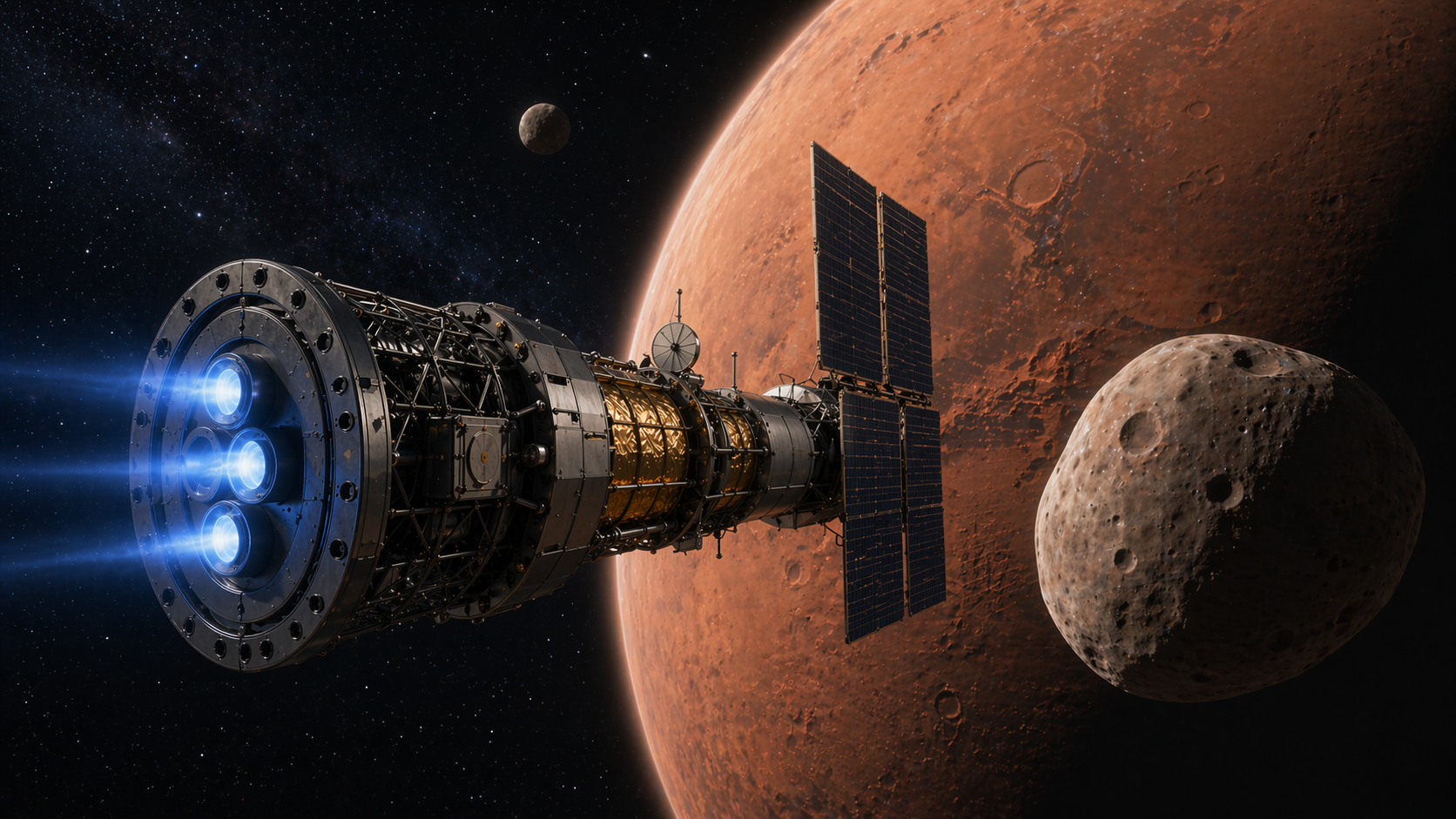
NASA’s shift from explosive thrust to continuous power—and what it makes possible
The checklist sits on a second monitor, half-hidden behind a telemetry window, while Alvarez leans back just far enough to see both without moving his chair. He came over from propulsion analysis five years ago, after a launch scrub that turned on a valve fault no one had modeled correctly, and he still keeps that report in a folder he doesn’t open. The spacecraft is already two days out, coasting on the last chemical burn, and the line he’s watching for is unremarkable: reactor enable, conditional.
He doesn’t say anything when it clears. He marks the time, then waits through the lag that always follows commands sent across that distance, long enough for doubt to creep in before the data returns and settles where it should.
“You don’t celebrate this step,” he says later. “You verify it, because if it’s wrong, you won’t get a second try.”
What changes in that moment doesn’t register as a spike or a surge. It shows up as continuity. Heat where there was none, electrical load that doesn’t decay, a thrust profile that begins and does not end. The spacecraft stops behaving like something that was thrown and starts behaving like something that works.
Call it a small thing—the difference between a push and a process—but it changes what the rest of the mission is allowed to become.
Alvarez learned his instincts on chemical systems, where propulsion is a short, decisive conversation with physics. You burn propellant, you get your delta-v, and then the system goes quiet, leaving guidance and small corrections to carry you the rest of the way. It is elegant and brutally constrained at the same time. You can reach a destination with precision, but you arrive with whatever you managed to pack at the beginning, no more and no less.
“We got very good at leaving,” he says, glancing back at a trajectory plot that is already obsolete. “Staying is a different problem.”
The reactor changes that problem by changing what the spacecraft does with time. Instead of converting fuel directly into thrust, the system converts heat into electricity and electricity into motion, feeding a set of thrusters that produce almost no force at any given instant. The force is slight enough to vanish into rounding errors over short intervals, which is why the curve the navigation team watches looks almost flat until it doesn’t.
A specialist on that team keeps a printout pinned to the edge of her console, the kind of chart that invites skepticism because it looks too gentle to matter. “It’s not acceleration the way people think of it,” she says, running a finger along a line that bends upward by degrees. “It’s accumulation. Leave it alone long enough, and it outruns what you expect.”
That curve shows up early in the mission design, shaping everything that follows. Once you commit to sustained low thrust, you commit to a different allocation of mass and risk. You carry less propellant, because you don’t need to spend it all at once, and you carry more capability, because the system that produces your motion also produces your power. The spacecraft becomes less like a projectile and more like a platform.
The first consequence is physical. If you are not devoting most of your mass to propellant, you have room for payloads that do more than observe and transmit. In NASA’s case, that includes helicopter scouts for Mars, small enough to travel as secondary cargo but capable of mapping terrain, identifying landing zones, and probing for subsurface water once they arrive.
The second consequence is temporal. A reactor that produces steady electrical output does not care whether the Sun is available, whether dust is in the air, or whether the environment aligns with your operating window. On the Moon, where night lasts roughly two weeks, solar systems shut down or rely on storage that adds mass and complexity. On Mars, dust storms can reduce solar output to a fraction of nominal levels for extended periods. A reactor continues.
“Power is what lets you make commitments,” an engineer working on surface systems says. “Without it, everything is provisional.”
The propulsion work feeds directly into the question of sustained presence. If you can launch, start, and operate a compact reactor in deep space, you have demonstrated a power system that can be set down on a surface and left to run through conditions that defeat alternatives.
In Idaho, where teams are developing what the Department of Energy classifies as microreactors, the target is not a city but a constraint. Diesel fuel that has to be shipped in over long distances, at costs that can exceed three hundred dollars per megawatt-hour in remote locations, defines the operating limits of entire communities and industrial sites. Replace that with a compact reactor that can run continuously for years, and the constraint changes character.
A project manager there, standing beside a mockup that occupies less space than most people expect, frames it in terms that echo the space program without trying to. “We’re trying to make nuclear behave like equipment,” she says, tapping the side of the unit. “Something you deliver, install, and depend on.”
Current designs aim for outputs in the range of a few to tens of megawatts electric, with refueling intervals measured in years and footprints small enough to be transported in modular sections. They do not replace centralized generation, but they change the arithmetic wherever the alternative is a fuel chain that can be interrupted, delayed, or priced beyond what the site can absorb.
In space, reactors are being scaled to the smallest viable systems that can support propulsion and survival beyond Earth orbit. On Earth, they are being scaled to the smallest viable systems that can be deployed where centralized infrastructure does not reach.
That is where the conversation turns, almost inevitably, to fusion.
A physicist who has spent much of her career on confinement systems answers the question without embellishment. “First you get a plasma that sustains itself,” she says. “Then you get net power. Then you get materials that survive. After that, you can talk about form.”
The order matters. Controlled reactions have been demonstrated, but continuous, economically viable operation requires maintaining extreme temperatures, sufficient particle density, and confinement long enough to produce more energy than is consumed, all while managing neutron flux that degrades structural materials and complicates fuel cycles. Each requirement is a boundary condition. Together, they define a system that has yet to stabilize.
Even if those hurdles are cleared, the path to smaller systems introduces its own constraints. Shielding does not shrink without consequence. Fuel handling imposes additional requirements. Thermal management becomes more difficult as systems compact.
“We’re still proving the plant,” she says. “Portability is a different conversation.”
NASA is not ignoring fusion. It is building with what can be engineered, tested, and flown within a timeframe that intersects with policy, budgets, and mission windows. Fission offers that path, along with a set of challenges that are understood well enough to manage, if not eliminate.
Those challenges introduce tension that does not show up in the clean lines of a trajectory plot. Launching a reactor requires approvals that extend beyond engineering into regulatory review and public scrutiny that have historically slowed or stopped similar efforts. Cost projections still compete within a budget environment that shifts with political cycles. Integration risks remain, particularly when adapting hardware originally designed for different roles.
None of that is visible in the data Alvarez watches.
By the time he closes his console, the numbers have settled into a pattern that no longer surprises him. The power draw is stable. The thrust profile matches the model within tolerances that would have been questioned a decade earlier.
He lingers a moment longer than he needs to, watching a line that moves slowly enough to resist interpretation, aware that its significance lies in what it will look like weeks from now rather than in what it shows tonight.
“This is the part that matters,” he says. “The part where it doesn’t stop.”
Outside, nothing marks the change. No light, no sound, nothing that would suggest a system has shifted from impulse to duration. Far beyond that horizon, a machine is still adding to its velocity, one quiet increment at a time.
⸻
Bibliography