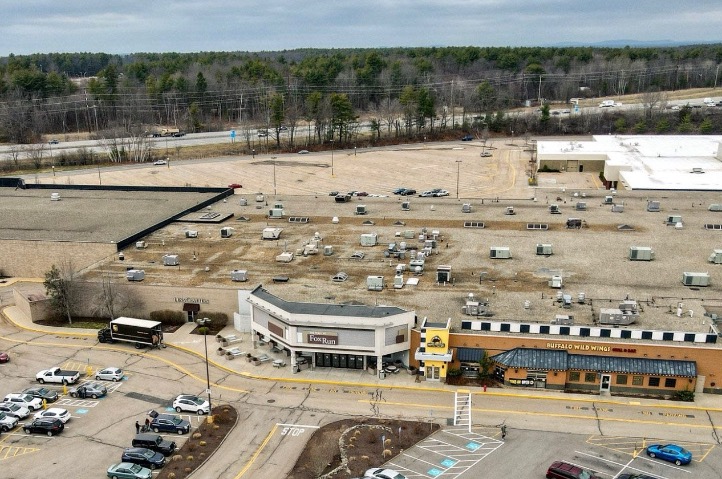
The chain-link fence went up on a damp morning off Durgin Lane, the kind of coastal gray that flattens everything into a single tone until you notice the details—a forklift idling, a worker dragging plywood across the old entrance of the Bed Bath & Beyond, the faint geometry of parking lines that still pointed toward doors that no longer existed.
A man in a heavy winter jacket stopped near the curb, looked across the empty lot where the Christmas Tree Shops and Bed, Bath, and Beyond had been, and said to no one in particular, “That place paid for a lot more than what they sold.”
It did, though not in a way most people ever saw.
The loss of retail doesn’t just remove a store. It removes one of the most efficient components in a municipal tax system—an asset that generates high revenue while placing relatively limited sustained demand on services—and replaces it with something that may be more valuable on paper but behaves differently once people begin to live inside it.
That shift is what Portsmouth is now working through on this site, and what Newington is still negotiating around at Fox Run Mall.
The difference isn’t philosophical. It’s structural.
In New Hampshire, property taxes don’t distinguish between residential and commercial rates. A dollar of assessed value is taxed the same way whether it comes from an apartment or a retail box, which gives the system a kind of surface simplicity that disappears the moment you account for what each type of property requires in return.⁵
Retail concentrates value.
A big-box store sits on a large parcel, produces a high assessed value, and generates steady tax revenue without sending children into the school system and while placing relatively limited sustained demand on municipal services. Police calls occur, maintenance is required, but the baseline cost profile remains low relative to the revenue produced.
A former Portsmouth assessor, speaking in what he described as a common shorthand used in municipal finance discussions, put it this way: “Commercial property pays for services it doesn’t use. Residential uses services it doesn’t fully pay for.”
That formulation isn’t a law, but it captures the direction of the imbalance seen in municipal finance studies across the country.⁷
In its later years, the Durgin Lane retail site was assessed in the range of roughly $25–35 million, according to city property records, generating on the order of $400,000 to $600,000 annually in property taxes depending on the assessment cycle.¹² It did so with minimal ongoing service demand, functioning as a quiet surplus contributor within the city’s budget.
What replaces it—Prescott Post—is financed at nearly $100 million and will likely be assessed somewhere near that level once stabilized, which pushes annual tax revenue closer to $1.5–$2 million under Portsmouth’s combined tax rate.³
On paper, that looks like a clear upgrade.
The complication arrives with the people.
Residential property doesn’t just contribute revenue; it introduces recurring demand that scales with occupancy—public safety calls, infrastructure use, and, most significantly, education costs tied to school enrollment. The impact varies sharply depending on the type of housing, which is where multifamily projects like Prescott Post behave differently from suburban subdivisions.
Apartments compress both value and cost.
Units are smaller, infrastructure is shared, and the number of school-aged children per unit is typically low. Portsmouth planning assumptions for comparable multifamily developments have used working estimates of roughly 0.1 to 0.2 school-aged children per unit, a fraction of what single-family housing generates, which keeps the added school burden within a range that can be offset by higher assessed value.⁴
A city councilor, speaking during a housing discussion last year, framed the tradeoff more cautiously: “Apartments don’t come free. But if the valuation is high enough and the student count stays low, they can carry themselves.”
That conditional is doing real work.
Portsmouth approved the Durgin Lane redevelopment without offering a large tax concession because the underlying math, while not frictionless, is strong enough to support private financing. The project secured nearly $100 million in construction funding without requiring the city to redirect future tax revenue back into the development, preserving municipal control over the full tax base once the buildings are complete.³
A few miles away, the same confidence doesn’t exist.
At Fox Run Mall, the redevelopment proposal has leaned on a tax increment financing structure that would allow the developer to retain a significant share of future tax growth to pay for infrastructure. The request signals a different set of conditions: a declining asset, higher redevelopment costs, and a use mix that may not reproduce the combination of valuation and relatively low service demand that retail once provided.⁶
A Newington official, speaking during a recent discussion of the project, captured the hesitation: “We can’t assume the replacement will behave like the mall did. It probably won’t.”
That uncertainty is the hinge between the two towns.
Portsmouth is replacing underperforming retail with high-demand housing in a market where rents, occupancy, and financing all support the transition. The city is not betting that housing is more efficient than retail; it is accepting a shift from a surplus-generating land use to one that is closer to balance, where revenue and service demand rise together and must be managed in tandem.
Newington is facing a harder problem.
The mall, even diminished, represented a form of land use that concentrated tax revenue while keeping municipal costs comparatively low. Replacing it means moving into a more complex fiscal structure where the margin between what a property contributes and what it requires becomes narrower and less predictable.
The asphalt at Durgin Lane is mostly gone now, broken into sections where foundations will be poured, and the site has begun to shift from a place people passed through to a place where they will stay.
What used to be a parcel that generated several hundred thousand dollars annually while drawing little from the system is becoming one that may generate closer to two million dollars while also introducing a steady stream of service demand tied to hundreds of residents.
That is the trade, expressed in concrete terms.
The land will likely produce more revenue than it did at the end of its retail life, but it will no longer function as a quiet surplus inside the city’s budget. It will operate closer to equilibrium, where value and cost move together, and where the fiscal stability of the system depends less on isolated high-yield parcels and more on the aggregate behavior of the people who live there.
The parking lot is gone.
In its place is something that carries its weight differently.
⸻
Bibliography
1. City of Portsmouth, NH – Property Assessment Records. Municipal valuation data for Durgin Lane retail parcels used to estimate prior assessed value and tax contribution.
2. Rockingham County Registry of Deeds – Parcel Records (Portsmouth, NH). Public land and ownership records supporting valuation range and site history.
3. Boston Real Estate Times – “$96.8 Million Secured for 360-Unit Apartment Project in Portsmouth, NH.” Reporting on financing and scale of Prescott Post development.
4. City of Portsmouth Planning Board Documents – Multifamily Development Reviews. Includes planning assumptions on school-age children per unit (approx. 0.1–0.2 range).
5. New Hampshire Department of Revenue Administration – Municipal Tax Rate Structure. Documentation confirming single-rate property tax system across property classes.
6. Town of Newington, NH – Public Meeting Minutes (Fox Run Mall Redevelopment). Discussions of proposed Tax Increment Financing (TIF) and redevelopment uncertainties.
7. Lincoln Institute of Land Policy – “Cost of Community Services Studies.” Research showing typical fiscal patterns of residential vs. commercial land use and service demand.
8. American Planning Association – Fiscal Impact Analysis Resources. Frameworks for evaluating municipal revenue versus service cost across land-use types.