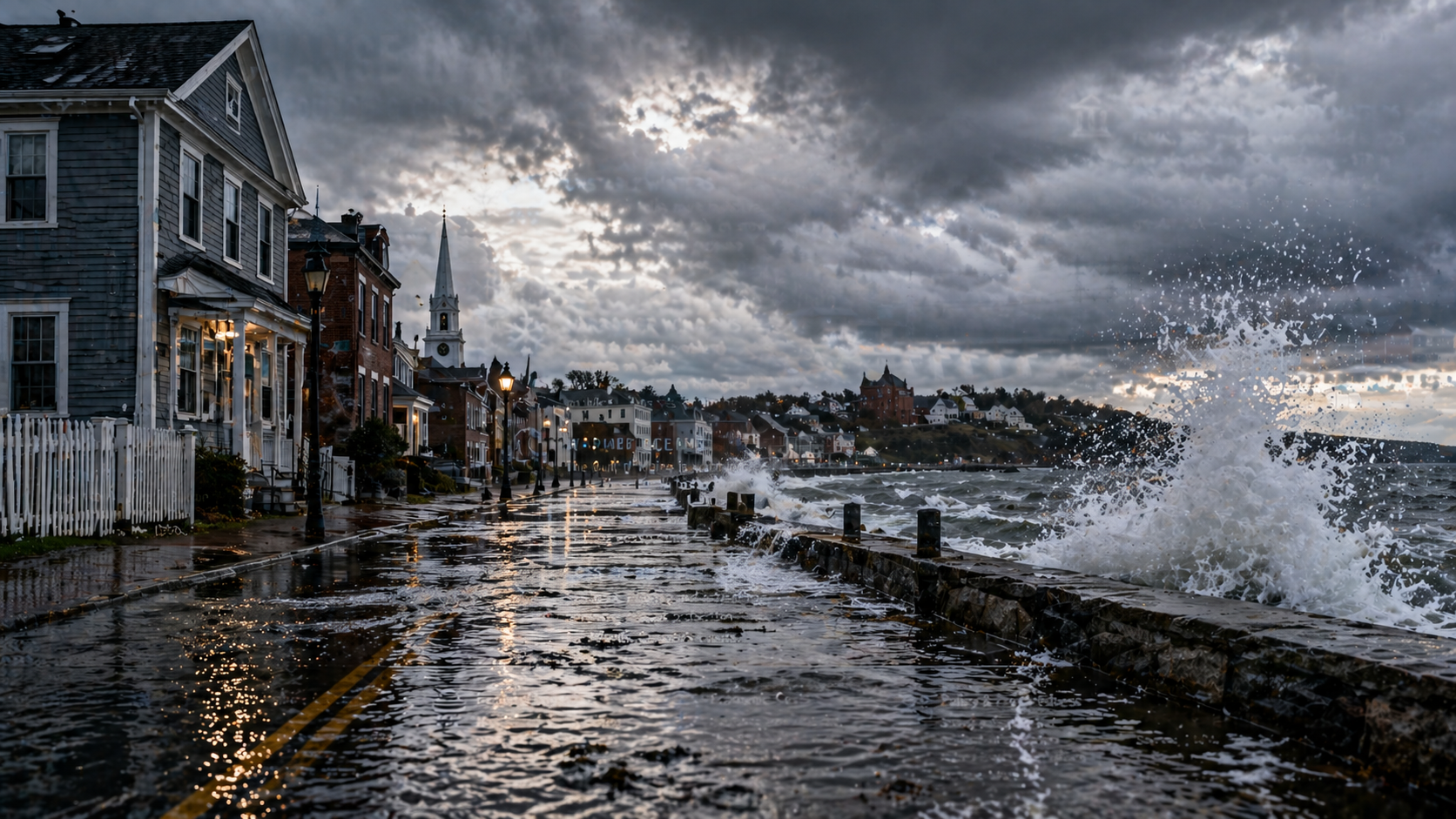
The tide doesn’t have to roar into Portsmouth to make its point.
Some mornings it just arrives a little too high, stays a little too long, and pushes through a piece of infrastructure that was built for a different version of winter. A storm drain that used to empty into the Piscataqua reverses direction. Water comes up instead of going down. It spreads across the street, finds the low spots, and holds there longer than it should.
No one calls it a disaster. Not yet.
A few blocks get wet. A basement takes on water. Public works adds another item to a list that never quite clears. By afternoon the tide falls back, the street dries, and the town returns to normal, which is to say, it absorbs the cost and moves on.
That’s how this story works here. It doesn’t announce itself. It repeats itself.
Nothing fails all at once. It just keeps costing more to live the same way.
Out in the Pacific, the setup is taking shape. The trade winds weaken, the warm pool that normally sits piled up in the western Pacific begins to slide east, and heat stored in the ocean is released into the atmosphere. That shift reorganizes the jet stream—strengthening the southern branch, loosening the grip of Arctic air over the northern tier, and redirecting where storms draw their energy and moisture.¹²
El Niño is part of the system. It always has been.
What matters now is where it lands.
The background climate has already moved. The ocean is warmer than it was during the last major El Niño events. The atmosphere is holding more moisture. When the Pacific releases heat into circulation, it isn’t adding variability to a stable system. It’s amplifying one that is already carrying more energy than it used to.³
That difference shows up in small ways first.
In New England, winter still arrives. It just arrives unevenly.
Cold comes, but it doesn’t always hold. Snow falls, but it doesn’t always stay. A storm drops a foot, then another follows with rain that cuts through it. The ground freezes, thaws, and refreezes until the surface starts to fail. The snow that does fall carries more water and does more damage when it comes down.
It is still the same winter people recognize. It just behaves less predictably inside its own boundaries.
The pressure shows up in how tightly systems have to operate.
Skiing is a capital problem now. Snow can be manufactured, but only inside a narrowing temperature window. When that window closes—even briefly—the investment disappears and has to be rebuilt.
Maple production is a timing problem. It depends on a narrow rhythm—freezing nights, thawing days. When winter drifts warm, that rhythm breaks. The season still happens, but not reliably.
Municipal systems absorb what neither can control. Rain on snow moves water faster than drainage was designed to handle. Freeze–thaw cycles degrade roads faster than they can be repaired. Heavy, wet snow does more damage than powder ever did.
The pattern is familiar. What changes is how often it repeats.
In Boston, high-tide flooding events have increased more than fivefold since the 1950s.⁴ Insurance markets have already adjusted. In parts of coastal New England, homeowners have seen premiums rise by 20 to 30 percent in recent years—or lost coverage entirely—as risk is repriced.⁵
Farther north, in Portland and Portsmouth, the same pattern plays out at smaller scale: more water, more often, moving through systems built for less of both.
The ocean is part of that shift. The Gulf of Maine has been warming faster than most ocean regions on Earth—at times roughly three times the global average.⁶ That warmth feeds coastal storms and narrows the margin between routine weather and damaging events.
Across Canada, that margin narrows further.
In Halifax and across Prince Edward Island and Newfoundland, sea ice once absorbed winter storm energy before it reached the coast. When that ice forms later, or not at all, storms meet open water instead, building wave energy over longer distances and delivering it directly to shore.⁷
Inland, in Quebec, the same shift changes the timing of water itself. Hydropower systems depend on predictable accumulation and release—snowpack building through winter and melting steadily in spring. When more precipitation arrives as rain, runoff comes earlier and faster, forcing operators to manage variability instead of seasonality.⁸
New England depends in part on that system, and in January 2026 a Hydro-Québec transmission line stopped exporting electricity for roughly two days during a cold snap as Quebec prioritized domestic demand. The U.S. Energy Information Administration described the interruption as a stress test for the region’s winter energy system.⁹
A flooded street is a public works issue. Repeated flooding becomes an insurance issue. Repeated losses and rising repair costs begin to affect how a town borrows.
Moody’s and other rating agencies have begun incorporating climate exposure into municipal credit assessments, noting that repeated infrastructure damage and rising insurance costs can weaken local fiscal positions and, in some cases, contribute to negative outlooks or higher borrowing costs over time.¹²
The Pacific shifts. The storm track follows. Water moves differently. The cost shows up somewhere else—in a premium notice, a bond discussion, or a utility bill.
Which brings the story back to policy, and to the one place where the United States still has leverage before damage becomes debt.
The Federal Emergency Management Agency is built to respond to disasters, but just as importantly, to reduce them before they happen. Programs like BRIC—Building Resilient Infrastructure and Communities—fund drainage upgrades, flood protection, electrical hardening, relocations from hazard zones, and the unglamorous work that prevents small failures from becoming larger ones.
In 2025, that program was canceled. In 2026, a federal court forced its reinstatement, restoring roughly $1 billion in mitigation funding after billions in projects had been frozen or delayed.¹⁰
The interruption matters more than the headline.
Projects delayed are not neutral. A culvert not upgraded this year fails under next winter’s runoff. A drainage system left undersized becomes a recurring problem instead of a solved one. The cost doesn’t vanish during the pause; it compounds into the next season.
At the same time, staffing reductions—thousands of FEMA departures over the past year—have raised concerns about response capacity, not for a single catastrophic event but for the accumulation of smaller ones that require coordination, reimbursement, and follow-through.¹¹
The vulnerability isn’t failure. It’s strain—more things bending at once, more often, for longer.
A strong El Niño would not create that condition. It would align it—bringing a warmer ocean, heavier moisture, storm tracks that lean toward the East Coast, and winter patterns that are less stable than the systems beneath them were designed to handle.
The Pacific is where the signal begins, but it does not stay there. It moves through the jet stream, into the storms, into the snow that does not quite hold and the rain that arrives at the wrong time, into the water that moves faster than the drains can take it and the coastlines that take the hit without the buffer they once had.
By the time it reaches New England, it no longer looks like a climate event. It looks like a series of ordinary problems arriving out of sequence—wet snow on power lines, water backing through a drain, a repair that costs more than the last one, a budget that stretches a little further to cover it.
Most of it will be fixed. It usually is. The street dries, the slope turns green, the culvert gets replaced, and the next storm arrives on a system that is slightly more worn and slightly more expensive to maintain.
Nothing collapses. The town holds. The region holds.
But it does so on different terms than it used to, with less margin, more cost, and fewer places for the stress to go.
And when the next season begins, it doesn’t begin from where it once did, but from wherever the last one left it—carrying forward the damage, the repairs, and the quiet adjustments that have already been made.
⸻
Bibliography
Moody’s Investors Service — Climate risk in municipal credit assessments, 2024–2025.