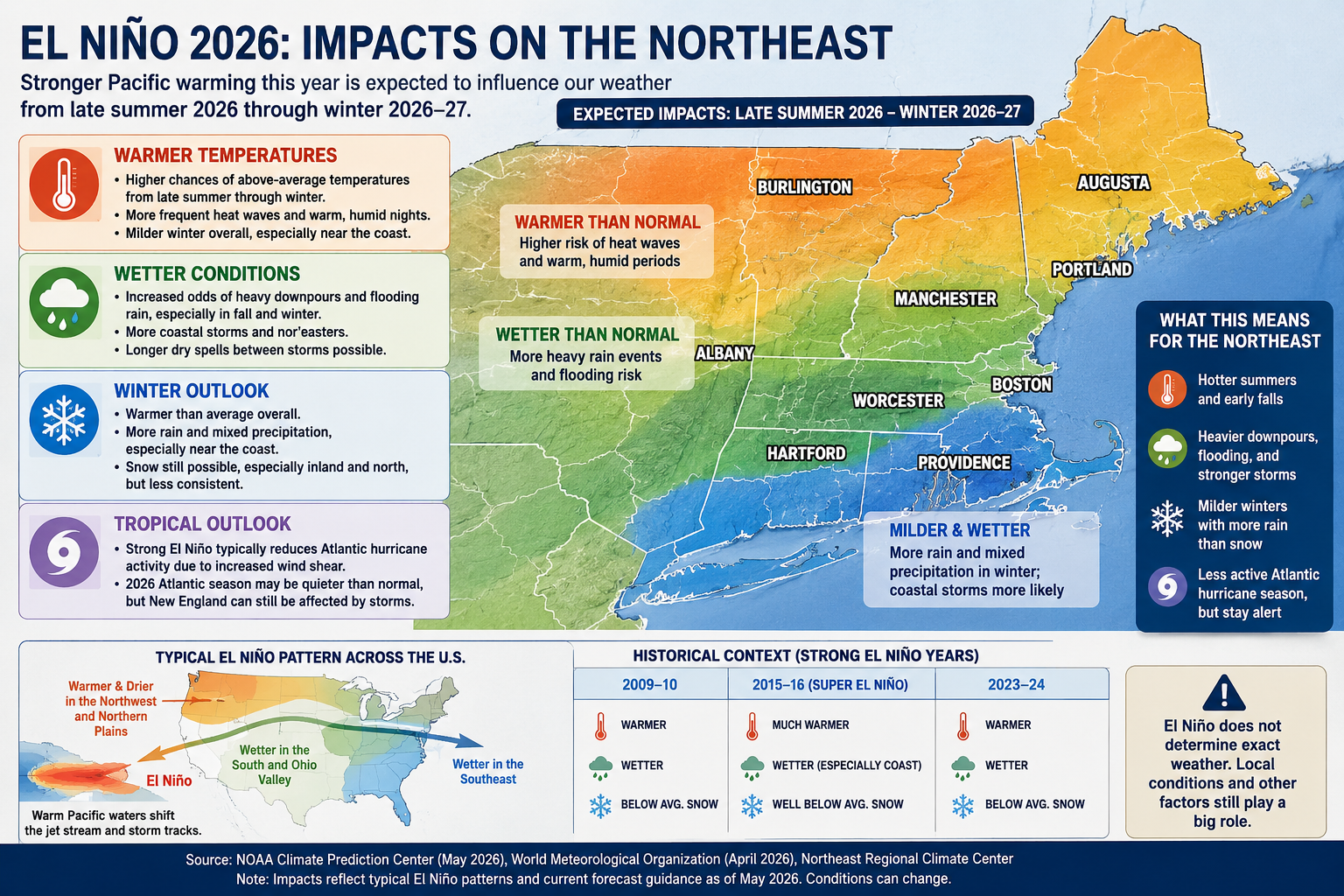
El Niño begins in the Pacific. In New England, it shows up where the region thinks it is safe.
The water won’t ask permission before it enters the house. Through the bulkhead, up through the floor drain, under the garage door, across the low road that always floods but somehow still surprises everyone — by then, El Niño will sound less like a Pacific climate pattern than a pump running in the dark.
El Niño begins far from New England, in the tropical Pacific, where ocean heat rises toward the surface and changes the way the atmosphere moves. By the time anyone here feels it, the science will have become ordinary life: heat that doesn’t break, rain that doesn’t drain, winter that doesn’t hold, and coastal water arriving where people have learned to pretend it won’t.
NOAA says El Niño is coming soon, with an 82 percent chance during May through July and a 96 percent chance that it lasts through the winter.¹ The Pacific hasn’t officially crossed the line yet, but the machinery is moving. Warm water is building beneath the tropical Pacific, and the models expect El Niño to develop soon. Its strength remains the open question.
That’s an awkward warning. It has no siren, no storm track, no red cone. It’s a forecast about conditions, and conditions are easy to ignore because they don’t yet look like damage.
New England doesn’t need a historic El Niño to have trouble. It only needs enough heat, moisture, and seasonal disorder to expose the places the region already knows are weak.
Every town has one: the road under the tracks, the stream behind the supermarket, the parking lot that becomes a pond, the basement with towels stacked near the bulkhead door. These are ordinary weak points.