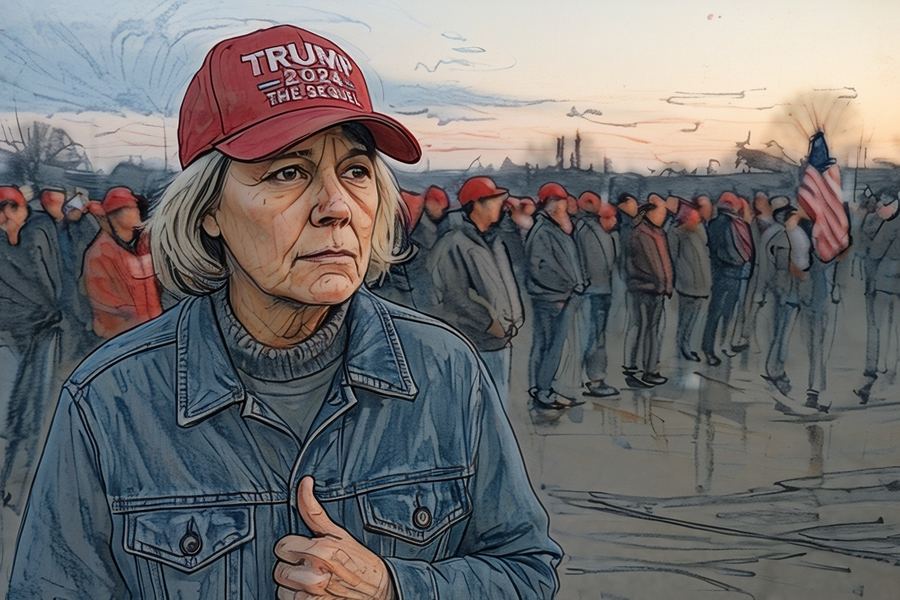
The smell of old auto exhaust rolled off the parking lot at Macomb Community College in Warren, Michigan. Dawn was just thinning the darkness, and winter’s freeze still whispered from the curbs. Suzanne Jennings, 65, stood in line, thumb hooked in her denim jacket pocket, her red “Trump 2024: The Sequel” cap pulled low. She told a reporter from The Guardian, “I totally believe he loves America. He loves us and he’s doing it.¹¹ Her voice wasn’t loud. It was quiet enough that you could hear the hum of nearby cars, the wind rising off the lot. But it lingered. Nodding faces in the crowd made it into a wave. In that moment you could see the faith and risk in equal measure.
That was how dreams begin: ordinary streets, familiar sounds, until something small tilts reality. Neuroscientist Erik Hoel calls it the overfitted brain, a state in which the mind learns its world too precisely and stops adapting. Dreams, he argues, are the system’s correction: bursts of dissonance that shake us out of complacency. America, in 2025, feels caught in one of its own. Hoel once wrote that dreams exist to increase generalizability via corrupted sensory inputs.² In plainer terms: an overfitted brain mistakes familiarity for truth.
By Day One of his return to power, President Trump began rewiring the machinery. He revived “Schedule F” — the classification that reassigns career civil servants as at‑will political staff. He ordered the removal of diversity, equity, and inclusion offices across agencies.¹ Within days, the federal bureaucracy’s spine was flexing. The news came like static: crackling, brief, hard to place, until the pattern emerged.
In Wheeling, West Virginia, the midday cold held onto the brick square. At a protest near the old First State Capitol, a grandmother in a red scarf held a sign: I am afraid for my grandchildren.