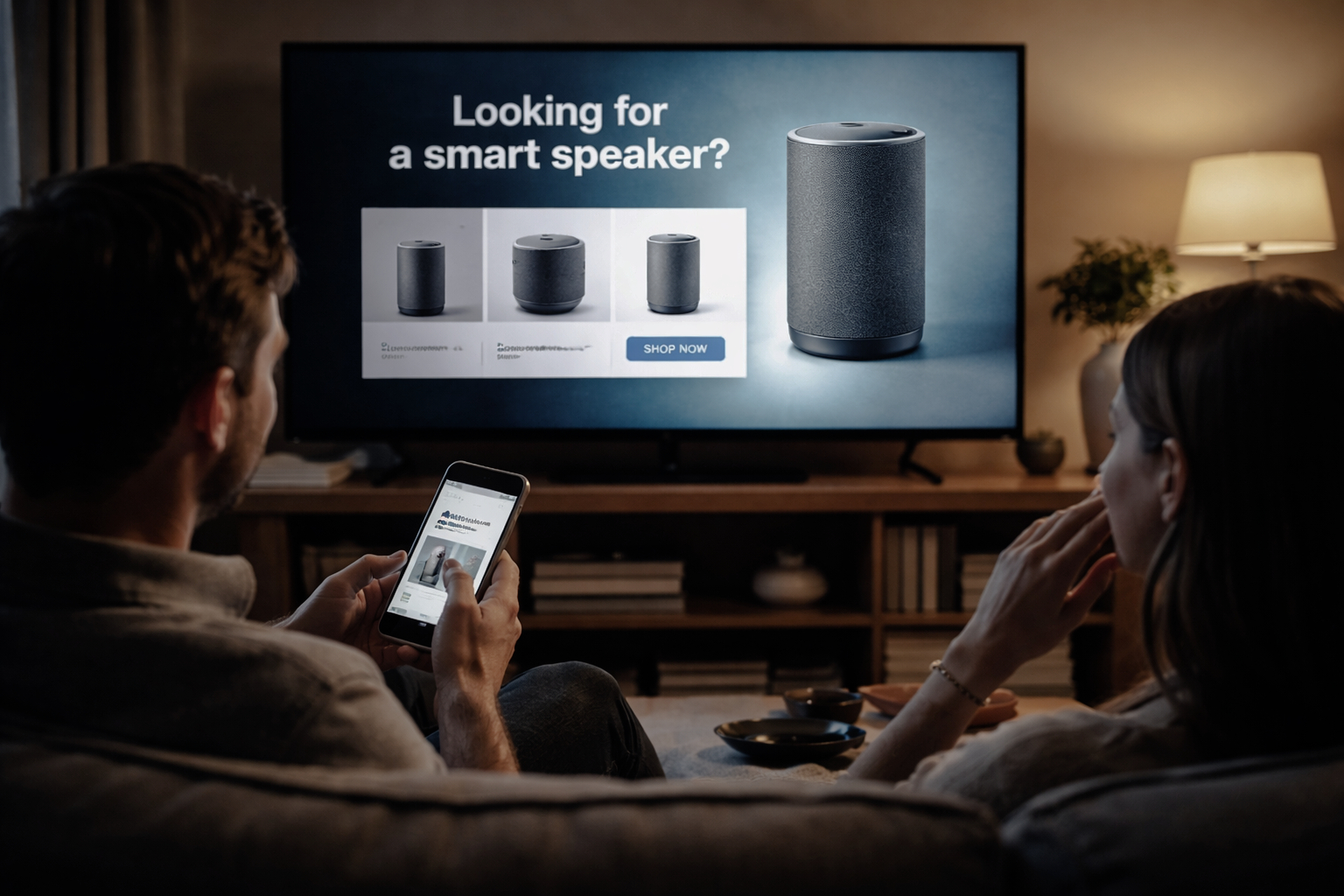
The television didn’t react when he picked up his phone, and that was part of what made the moment unsettling rather than obvious.
It kept playing, voices folding into the room while he searched for a gift he hadn’t quite decided to buy, scrolling through options without urgency, the way people do when the choice isn’t important yet. In the kitchen, his wife paused mid-motion and called out—not alarmed, just caught off guard by something that didn’t quite fit.
“Why is this asking me about this?”
He turned toward the screen at the same moment, not because he expected anything, but because something in her tone suggested a connection. The ad that had just appeared tracked his search too closely to feel accidental, aligned not only with what he had looked up but with how recently he had done it, as if the room had registered the action before either of them had finished thinking about it.
Nothing had been said out loud, and nothing had been shared in any deliberate way. What lingered wasn’t the accuracy—which could be explained if you chose to spend the time on it—but the timing, which made the explanation feel beside the point.
The system had already done the work.
In 2017, the Federal Trade Commission found that Vizio televisions were collecting viewing data from more than 11 million households, capturing what appeared on screen on a “second-by-second basis” without what it called “viewers’ informed consent.” The system did not wait for interaction or depend on explicit input; it recorded whatever passed across the screen, converting an ordinary room into a continuous stream of behavioral data that could be stored and matched elsewhere.
The more consequential detail is not the recording but the movement that follows it, because the same filing notes that Vizio sold that information to third parties, turning the room itself into a point of extraction within a larger system of transfer and use. What feels like a contained, private environment becomes part of a chain that extends well beyond it, not because anything changes in the room, but because something else has been running alongside it the entire time.
The television does not announce the change because nothing in the room has to change for the system to function.
Before sunrise in Vinalhaven, Frank Thompson steps onto his boat, the boards shifting slightly under his weight as he checks the lines and pushes off into water that looks unchanged, the same horizon stretching outward, the same work unfolding through habit rather than decision. The motions carry him forward without much thought, the result of years spent doing the same thing until it no longer requires explanation.
For most of his life, that work carried its own limits. You went out, you did the job, and the details stayed with you unless you chose to share them. It was not enforced so much as assumed, a condition of the environment rather than a rule that needed to be stated.
Now the environment includes a system.
A device on Thompson’s boat records its location continuously—hauling traps, tied to the dock, heading home—building a record that does not stop when the work stops and does not require a reason to exist. He is not under investigation, yet the system runs because the job now includes being recorded as part of doing it.
“You used to go out and that was your business,” one lobsterman said. “Now it feels like somebody’s riding with you.”
That sentence carries more precision than the formal description that sits beside it, even though both describe the same system. Regulators frame the tracking as a way to understand patterns and manage the fishery, and the data does exactly that, producing insights that would otherwise remain out of reach.
What the description does not capture is duration, because the system does not check in and out; it remains, accumulating information in a way that gradually changes what can be known.
The Supreme Court has already described the implications of that accumulation. In Carpenter v. United States, it called long-term tracking an “intimate window into a person’s life,” a phrase that does not depend on why the data was collected but on what becomes visible once it exists.
That applies just as easily to work as it does to suspicion, because the mechanism does not distinguish between them.
A truck driver heading down Interstate 95 encounters the same shift in a different form, with an electronic logging device that records movement, driving time, and rest automatically, producing a record that continues whether anyone checks it or not. The rule improves safety, and that matters, but it also means the system does not need to be activated or directed, because it is already operating as part of the job itself.
Elsewhere, law enforcement agencies purchase location data collected by ordinary smartphone applications—navigation, weather, retail—each one capturing movement as part of its normal operation. One official described the capability with a clarity that leaves little room for interpretation: “We can follow a device… from place to place,” a sentence in which the distinction between device and person holds only briefly before collapsing into use.
The system does not begin with a question about a person. It begins with data that already exists.
Back in the living room, the television has already moved on, the earlier moment dissolving because nothing about it demanded attention in the first place. That is how the system holds: it does not interrupt or declare itself; it continues, quietly extending what it records until accumulation becomes the only meaningful event.
At the dock, Thompson ties up in the late afternoon, the light flattening across the water as he secures the lines and shuts down the engine, the day ending in the same sequence it always has. What changes is not the work but what continues alongside it, because the system that records his movement does not recognize the end of the workday as a boundary worth observing.
When you step back far enough, what comes into focus is not a single system but several systems overlapping until they begin to read as one, each justified on its own terms while contributing to something none of them was explicitly designed to produce. A television captures viewing data for advertising, a boat transmits location for regulation, a truck logs movement for safety, and a phone reports position for convenience, all operating independently while reinforcing the same underlying pattern.
The shift becomes visible over time, not because everything is captured, but because enough is captured to make the rest unnecessary. Systems collect continuously and defer judgment, allowing patterns to emerge from accumulation rather than from intent, which reverses an older order in which observation followed suspicion.
In that reversal, the individual is no longer the starting point of attention but the result of it, assembled from records that already exist and interpreted only when necessary.
The television is still on, the room unchanged in any way that would draw notice, and at the dock the last light fades as Thompson steps away from the boat, the water settling into a slower rhythm that suggests closure even as the record continues to grow.
Nothing in either place signals that anything has changed.
What has changed is that nothing needs to.
⸻
Bibliography
1. Federal Trade Commission. “Vizio to Pay $2.2 Million to FTC, State of New Jersey to Settle Charges It Collected Viewing Histories on 11 Million Smart Televisions Without Users’ Consent.” February 6, 2017. Documents second-by-second tracking and sale of television viewing data without informed consent.
2. Regional reporting on Maine lobstermen and federal vessel tracking requirements. Provides firsthand accounts of continuous monitoring concerns and perceived loss of autonomy among working fishermen.
3. Supreme Court of the United States. Carpenter v. United States, 585 U.S. ___ (2018). Establishes that long-term location tracking reveals an “intimate window into a person’s life.”
4. Electronic Frontier Foundation and related reporting on commercial location data tools such as Fog Reveal. Documents law enforcement use of app-derived tracking and operational capability to follow devices across locations.