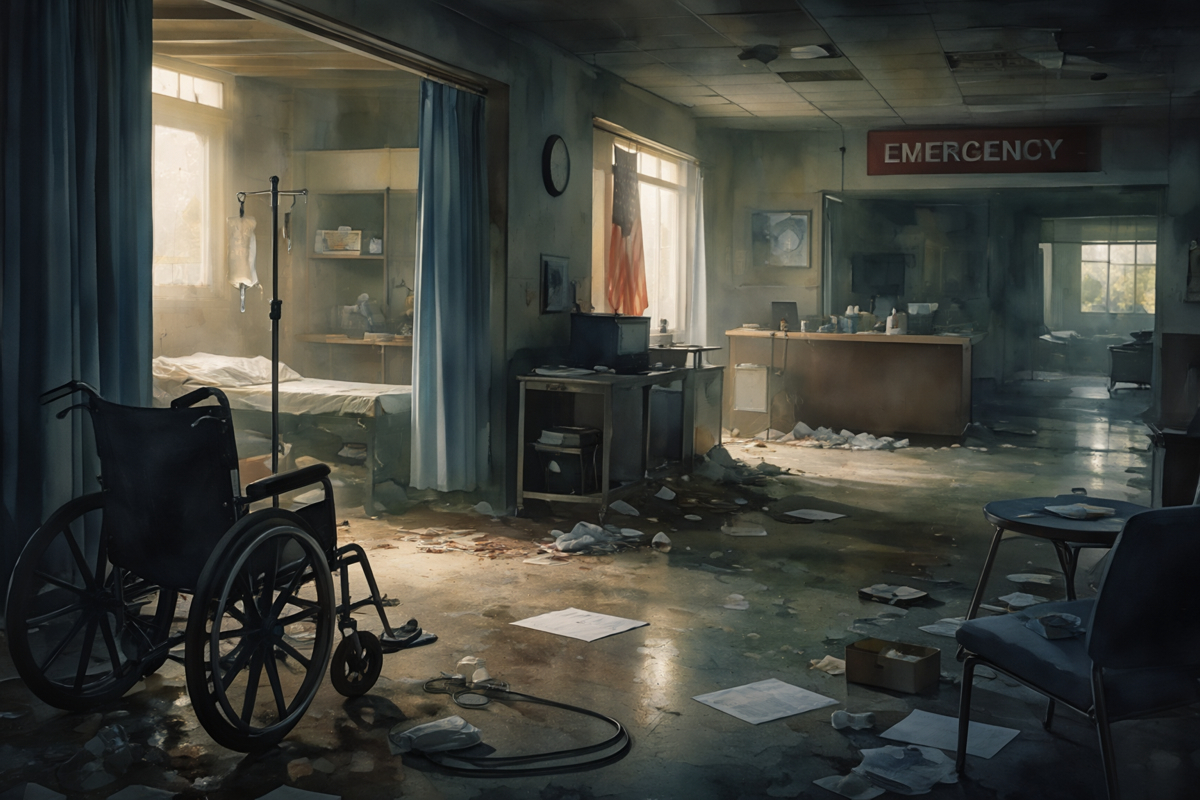
This is the year America stepped away from the sick and poor. I didn’t write that sentence lightly. It is part of a personal reckoning I’ve been doing as 2025 closes—trying to make sense of what has been done to this country not through tweets or rallies, but through policy signatures that never make the evening news. In the last installment, it was privacy. Today, it is health. And it is harder to look at, because the people paying the price rarely get to tell their story.
The political story in Washington begins one way. The human story begins another.
In Arkansas, Cecelia “CeCe” Crawford lost Medicaid not because she stopped working, but because she didn’t have internet at home. Under Arkansas’s work-requirement policy—first tested years ago, then revived in 2025 under new CMS guidance—recipients were required to log monthly online work activity to remain eligible. “I didn’t miss work. I missed one report,” she told Kaiser Health News. “They cut me off anyway.”¹
What happened after that is the part policy writers rarely follow: CeCe skipped blood-pressure medication for months, ended up in the ER, and left with $12,000 in medical debt. Arkansas wasn’t a one-off; it was a preview. A rule change from the Trump-led Department of Health and Human Services (HHS) in early 2025—described by the agency as “Medicaid Optionality”—gave states the power to convert Medicaid into capped programs and remove eligibility categories, including low-income adults without children.² Texas, Florida, and Tennessee immediately signaled they would begin disenrollment reviews.
In Denver, the impact didn’t show up first in spreadsheets—it showed up in triage. A Denver Health ER nurse told The Denverite in June, “We started seeing kids come in sicker because they hadn’t had meds in weeks.”³ The nurse didn’t mention names. She didn’t need to. Anyone who works in pediatrics knows exactly which children those are: asthma, diabetes, epilepsy—conditions where a missed refill changes the course of a life.
Policy analysts often insist stories don’t prove policy. But when you see the pattern repeat, state after state, clinic after clinic, you stop needing theory.
The Affordable Care Act was not repealed in Congress—it was weakened in the bureaucracy. In February 2025, HHS announced it would terminate cost-sharing reduction payments, which subsidize out-of-pocket costs for lower-income ACA marketplace customers.⁴ That same month, a reinterpretation of Section 1557 of the ACA re-allowed “short-term limited-duration” health plans—insurance in name only—policies that exclude cancer care, maternity care, mental-health treatment, and prescription drugs.⁵ The administration framed them as “choice.” But as one cancer patient learned, choice is meaningless if your doctor won’t start chemotherapy without real insurance.
Her name is Michele Ray Smith, a Tampa resident interviewed in a Kaiser Family Foundation patient case archive. When her marketplace subsidy was disrupted during an administrative halt, her insurer notified her that her plan was inactive. “My doctor told me: ‘We can’t schedule chemo unless insurance is active.’ I had to wait 27 days.”⁶ The Tampa Bay Times later covered the wave of Florida patients who experienced similar sudden disruptions.⁷ Most articles never reported what happens during twenty-seven days of tumor growth. But the oncologists know.
The domestic retreat from health wasn’t limited to insurance. It extended to public-health infrastructure—the part of medicine that is invisible until it fails. CDC regional staffing fell sharply after a combination of hiring freezes and grants cut to state health departments⁸, and the Department of Homeland Security moved to limit use of federal epidemiological data-sharing that once coordinated disaster response.⁹ Surveillance slows. Outbreaks spread before they have names. And no proclamation will reverse that lost time.
But to understand what the U.S. did this year, you have to look beyond U.S. borders.
In January 2025, the United States ordered a sweeping 90-day freeze on nearly all foreign aid, including global health programs that provide HIV antiretroviral therapy, tuberculosis treatment, maternal-health support, and vaccination infrastructure—programs that reach tens of millions.¹⁰ UNAIDS warned that “treatment interruptions place millions of lives in jeopardy.”¹¹ Reuters reporting confirmed that more than 80% of USAID health programs were canceled within six weeks.¹² Staff were placed on administrative leave. An agency that normally employs 10,000 was reduced to under 300 active personnel.¹³
A USAID Office of Inspector General report warned that $8.2 billion in humanitarian aid sat unspent and without oversight, risking diversion, waste, or expiration.¹⁴ A federal judge later ordered a partial lift of the freeze, ruling that it lacked procedural justification and was actively harming humanitarian delivery.¹⁵
The damage wasn’t limited to numbers. It has a face.
In South Africa’s KwaZulu-Natal province, HIV-prevention clinics documented abrupt loss of access to PrEP, the medication that reduces HIV transmission by up to 99% when taken correctly.¹⁶ According to Reuters, **2.5 million people worldwide lost access to PrEP after donor funding was suspended.**¹⁷ UNAIDS went further: eight countries risked running out of HIV medicines entirely.¹⁸
A global study cited by Reuters found that development-aid cuts—including U.S. cuts—could contribute to 22.6 million additional deaths worldwide by 2030, including 5.4 million children under the age of five.¹⁹ Those numbers do not measure sorrow, or skill lost, or the cost of a village’s teacher dying before her students graduate. They simply count bodies.
When I began writing this piece, I thought the story might be about budgets. It’s not. It is about a philosophy. In federal rulemaking and memos and waivers that will never trend on social media, the U.S. signaled to the world—and to its own people—that healthcare is optional.
America once defined itself by what it built—the TVA, the interstate system, the moon landing. This year, it defined itself by what it chose not to build.
I look outside now, past the window where winter is arriving again. The wind has shifted off the Atlantic. The cold will get worse before it gets better. And somewhere near the wood stove, Sofia is asleep—curled into herself, breath slow, trusting the house to hold.
It is hard not to think of the millions of people this country once sheltered—who now live without that kind of warmth.
⸻
Bibliography (Chicago-Style)
1. Kaiser Health News. “Arkansas Medicaid Recipients Say Internet Log-In Requirement Led to Coverage Loss.” KHN reporting citing interview with Cecelia Crawford.
2. U.S. Department of Health and Human Services. Medicaid Optionality Rule, 2025. Federal rule change permitting state block-granting and eligibility removal.
3. The Denverite. Local reporting on pediatric ER testimony regarding Medicaid lapse and asthma medication gaps.
4. U.S. HHS. Notice of Termination of Cost-Sharing Reduction Payments, February 2025.
5. Federal Register. Rule Reinstating Short-Term Limited-Duration Health Plans, February 2025.
6. Kaiser Family Foundation. Patient Case Archive – Interview with Michele Ray Smith, Tampa, FL, regarding chemotherapy delay.
7. Tampa Bay Times. Coverage of ACA marketplace subsidy disruptions affecting Florida cancer patients.
8. CDC Budget Summary and Appropriations, 2025. Staffing and grant reduction data.
9. DHS Policy Memo on Epidemiological Data-Sharing Limitations, April 2025.
10. Reuters. “Trump Halts Foreign Aid, Including AIDS Relief and TB Funding.”
11. UNAIDS. Press statement on U.S. foreign aid freeze: “Treatment interruptions place millions of lives in jeopardy.”
12. Reuters. “Trump Administration Scraps Over 80% of USAID Programs.”
13. Wikipedia. “2025 United States Federal Mass Layoffs.” Summary of USAID employment collapse.
14. Reuters. “Watchdog Warns USAID Freeze Leaves $8.2B Unspent with No Oversight.”
15. AP News. “Federal Judge Orders Partial Lift of USAID Funding Freeze.”
16. HIV Prevention Program Clinical Reports, KwaZulu-Natal region, cited in Reuters.
17. Reuters. “Global Funding Cuts Devastating HIV Prevention Programmes, UNAIDS Says.”
18. WHO/UNAIDS joint statement: eight countries at risk of HIV medication depletion.
19. Reuters. “Aid Cuts Could Result in 22.6 Million Deaths Worldwide by 2030, Study Finds.”