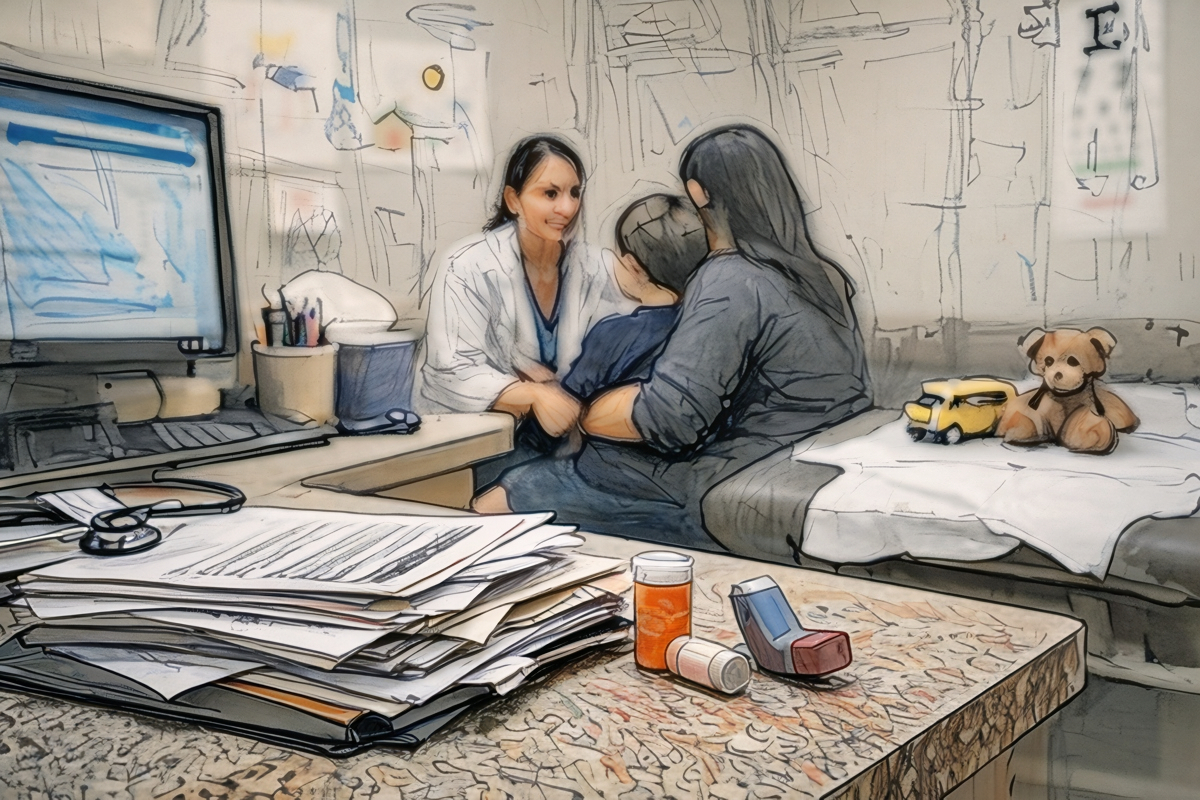
The exam room smells like hand sanitizer and powdered gloves — that sharp, clean scent that promises order. It’s the smell of systems that are supposed to work.
Dr. Dolly Lucio Sevier smells it every day.
This morning she’s trying to calm a five-year-old boy who can’t explain why he keeps coughing. His mother hands her a plastic envelope stuffed with discharge papers from three different detention facilities. The medication lists don’t match. The dates don’t line up.
The system has already processed the child.
What it has not done is keep him medically intact.
That is the mechanism.
Emergency immigration authority is built to move people quickly across facilities and jurisdictions. Pediatric care is built to follow a patient over time. When those two systems intersect, speed breaks continuity, and continuity is what keeps children stable.
The boy laughs anyway, pressing a toy truck into the paper lining of the exam table, drawing roads that connect nothing. His breathing rattles when he does.
Sevier flips through the paperwork slowly. Not because she needs time to read it, but because parents watch doctors carefully in moments like this. They are looking for signs that everything makes sense.
The forms do not make sense.
She asks where the boy received his last treatment. The mother traces her finger along a facility name printed in faint ink and shrugs. She lost track after the second transfer.
The symptoms are manageable.
The medical history is not.
Over the past several years, Sevier has testified before Congress about cases like this. Immigration enforcement rarely arrives in pediatric medicine as policy. It arrives as missing prescriptions, interrupted vaccination schedules, and custody records that travel more reliably than treatment records.
“When children are moved repeatedly through facilities, their medical care often becomes fragmented, incomplete, or lost entirely,” she told lawmakers.¹
That fragmentation is not an accident. It is a consequence of how the system is designed to operate under emergency authority—fast, flexible, and indifferent to continuity.
In pediatric medicine, continuity is the treatment.
Asthma worsens when inhalers don’t follow the child. Respiratory infections escalate when monitoring stops between transfers. Chronic conditions that require stability encounter a system that resets the clock every time a child moves.
The emergency begins somewhere else.
It lands here.
Yazmin Juárez experienced that speed directly. She crossed the border seeking asylum with her nineteen-month-old daughter, Mariee. During detention, the toddler developed a fever and persistent cough. Juárez later testified that she repeatedly asked staff for medical care.
“My baby was coughing and had a fever. I told them she was sick, and they told me she was fine,” she said under oath.²
Mariee died soon after release.
A federal investigation later concluded that medical failures during detention contributed to her death.² The system had processed her case. It had not sustained her care.
The same pattern appeared in the death of seven-year-old Jakelin Caal Maquin. She developed dehydration and shock while in Border Patrol custody. Her father described the final hours without interpretation.
“She had a fever, and she started vomiting. They took her to the hospital, but it was too late.”³
After these deaths, screening protocols were revised.
But screening is intake.
Continuity is survival.
Dr. Colleen Kraft of the American Academy of Pediatrics saw the downstream effects during facility visits.
“When you take children away from their parents and place them in these detention settings, the damage can be profound and long lasting,” she said.⁴
The damage does not remain inside detention.
It follows.
In Nashville, school social worker Ana López watched a third-grade student disappear mid-semester after a workplace raid detained the child’s mother. Teachers prepared report cards with nowhere to send them. Medical files and counseling notes sat in the office, disconnected from the child they belonged to.
“We weren’t just missing a student,” López said later. “We were missing everything that kept her stable.”⁵
The system had moved faster than the institutions around it.
That mismatch does not resolve itself.
In Los Angeles County, public-health officials observed declines in vaccination participation following enforcement surges. Outreach workers reported parents delaying clinic visits out of fear that records might expose family members.
“Fear of enforcement has reduced participation in preventive care and vaccination programs,” the department concluded.⁶
Fear does not appear in enforcement data.
It appears later, in missed appointments and untreated illness.
Back in the exam room, Sevier notices another pattern. Families hesitate before answering questions. They ask whether medical records are private. They want to know who can see what.
Trust becomes a clinical variable.
And trust, once broken, behaves like a missing medication—it changes outcomes long after the initial event.
Emergency authority is designed to move quickly. Hospitals, schools, and public-health systems are designed to move slowly. When those speeds collide, the slower systems don’t accelerate.
They absorb the damage.
Over time, emergency enforcement stops feeling temporary. It becomes embedded in how institutions operate. Clinics adapt intake procedures. Schools track absences differently. Public-health departments adjust outreach strategies around fear rather than access.
What began as a surge becomes structure.
The most visible numbers appear in press releases—detentions, transfers, encounters. The less visible consequences accumulate in exam rooms, attendance records, and vaccination gaps.
Sevier sees those consequences in fragments.
Another child arrives with uncontrolled asthma after multiple transfers. The symptoms stabilize once medication resumes. The harder task is reconstructing care across incompatible records, gaps in treatment, and missing information.
The plastic envelope rustles as she opens it again. Dry. Creased. Traveled.
Emergency authority changes policy quickly.
It changes systems slowly.
By the time those changes are visible, they no longer resemble emergency. They resemble normal operations, with the same disruptions repeating under different names.
The sanitizer still smells clean.
The paperwork still smells like paper.
The waiting room still fills.
And children continue arriving with envelopes that document where they have been while revealing almost nothing about the care that followed them there, moving through a system that processes them efficiently while quietly losing track of what keeps them well.
⸻
Bibliography
1. U.S. House Committee on Oversight and Reform. Testimony of Dr. Dolly Lucio Sevier. Congressional record on pediatric care disruptions in immigration detention.
2. U.S. House Committee on Oversight and Reform. Testimony of Yazmin Juárez. Documentation of medical care failures leading to death of Mariee Juárez.
3. Associated Press; Washington Post. Coverage of the death of Jakelin Caal Maquin (2018). Reporting on medical events in Border Patrol custody.
4. American Academy of Pediatrics. Statements by Dr. Colleen Kraft following detention facility visits. Pediatric assessment of psychological and medical harm.
5. ACLU; education advocacy reporting on student displacement. Documentation of school and medical record disruption following enforcement actions.
6. Los Angeles County Department of Public Health. Vaccination participation analysis following enforcement activity. Evidence of reduced preventive care utilization.