I didn’t hear the shot as a shot.
What I saw first was the reaction.
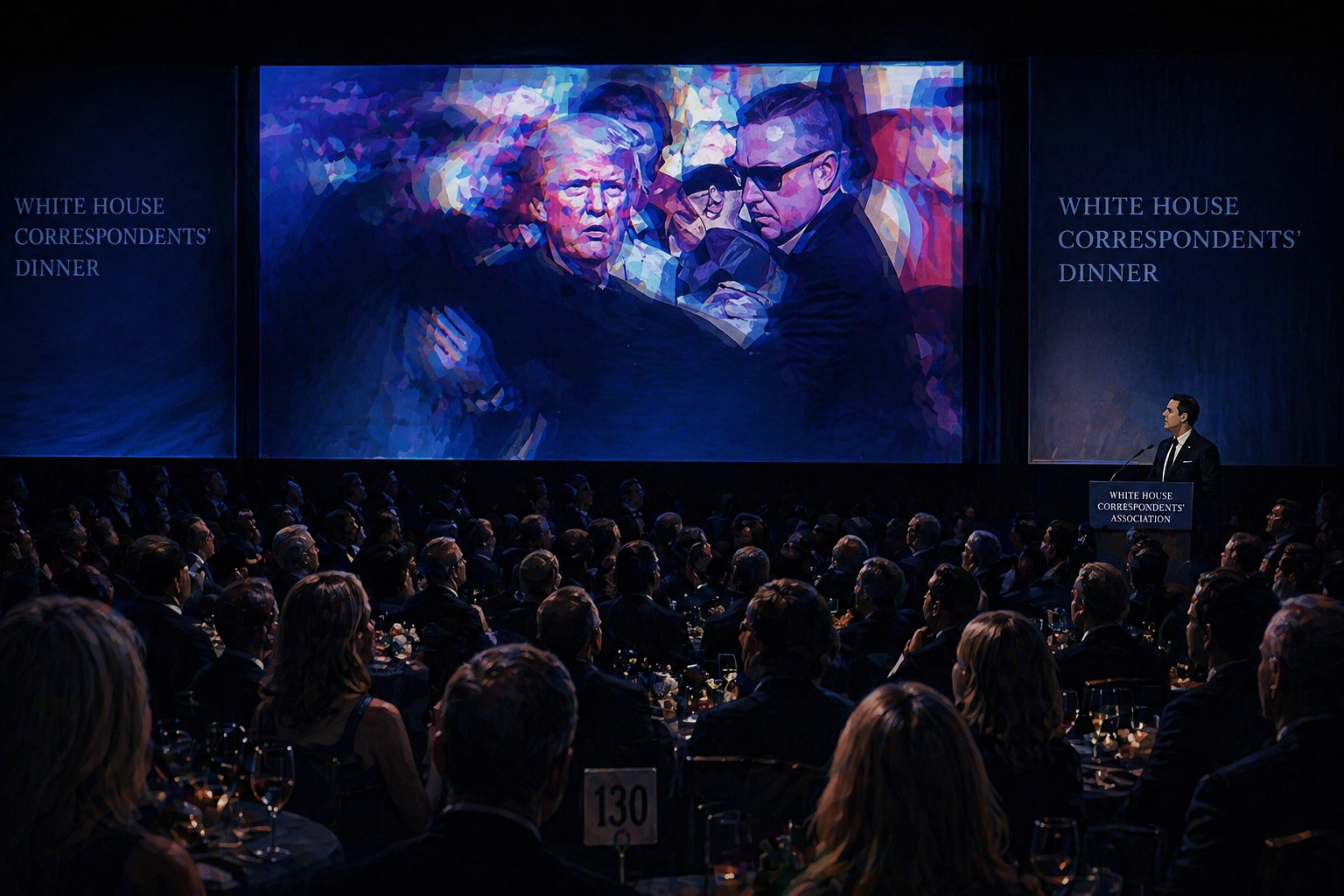
It came through the television during the Correspondents’ Dinner, where the rhythm had already started to break, the tone shifting just enough that the interruption didn’t feel like a break so much as a continuation.
For a moment, it wasn’t clear what had happened.
Only that it had.
The program kept moving, as if the moment hadn’t decided what it was yet, and in that space—before anything settled—you could feel the explanation starting to form, not out of what had happened, but out of what it already fit.
Two days later, watching an interview on 60 Minutes, the same event returned in a different form.
Norah O’Donnell read aloud from notes left behind by the shooter, bringing it into the room slowly, deliberately, as if it might finally resolve into something you could hold onto. For a moment it did, suspended between what had happened and what it might mean.
Then, before the question had fully landed, the exchange shifted.
Donald Trump didn’t respond to the content of what she had read. He turned toward her instead, redirecting the moment away from the notes and toward the interaction itself, and in doing so changed what everyone was now watching.
Nothing new had been introduced.
Only the focus had changed.
The effect was immediate. The event receded. The exchange took its place.
That’s the break.
Events don’t settle the way they used to.
Once that process starts, interpretation doesn’t follow the event so much as compete with it.
I had seen the clip before.
Months earlier, during the last stretch of the election, when everything moved quickly and nothing seemed to stay in place for long. At the time, it didn’t feel finished. The sound arrived first. The reaction followed. It passed the way things moved then—before it had fully settled into anything.
Watching it again now, it was different.
By then, the moment had already been pulled apart and put back together into something that could be repeated, compressed into a sequence that seemed to settle on its own. On my phone, it unfolded quickly: the hand moved, the blood appeared, and the space between those two things closed in a way that didn’t require anything else.
I paused it at the same place each time without quite deciding to, holding the frame as if the stillness might settle something the motion hadn’t.
It didn’t.
It sharpened it.
Because once the moment could be stopped, it began to behave differently, shedding what didn’t fit inside the frame and holding onto what did, until the sequence carried a kind of closure it hadn’t needed when it was still happening. The hand was already there. The blood was already visible.
That version felt complete.
At full speed, it didn’t.
Watching it through without stopping, the motion loosened again. The sound came first. The reaction followed. For a moment, it opened back up into something that hadn’t decided what it was yet.
That version didn’t travel.
The tighter one did.
I sat there with the engine still off, the phone screen brighter than the windshield, and let the clip play through without stopping it, watching it move the way it had the first time—uneven, unresolved—until it felt closer to what I had seen then, if only briefly, before slipping again into something more complete.
The event itself had lasted only a few seconds, but by the time I was watching it again, the explanation had already moved ahead of it, settling into something clearer and more certain than the moment itself had ever been.
Once it reached that point, it was difficult to return.
⸻
Bibliography