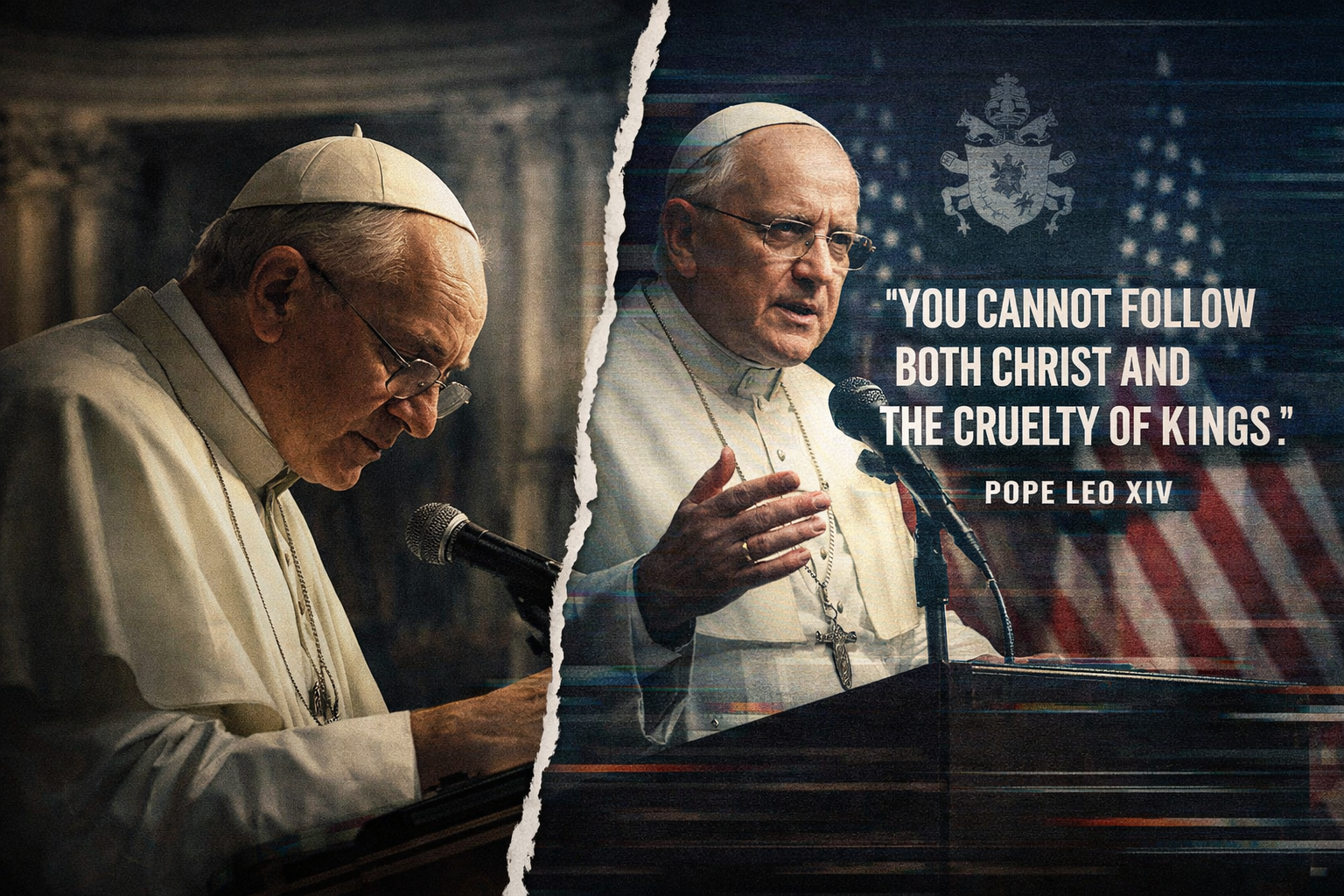
The man at the counter wasn’t trying to start anything. He was just waiting for his coffee, still damp from the walk in, scrolling the way people scroll when they’ve got a minute to burn and nothing in particular to find, when he stopped and read the line out loud, almost like he was testing how it sounded in the air.
“Pope Leo said this.”
He angled the phone slightly so the woman next to him could see it—white text, black background, a small papal crest tucked into the corner in that understated way that signals authenticity without insisting on it.
“You cannot follow both Christ and the cruelty of kings.”
She leaned in and read it once, then again, her expression settling into recognition before verification. “That’s… pretty direct,” she said, not quite asking a question.
He gave a quick nod, like something had finally clicked into place. “Yeah. Finally.”
It felt right, which is what made it easy. It sounded like something a pope would say if he had decided to stop circling and just land the point cleanly, and because it fit that expectation so well, it didn’t create the kind of pause that might have led anyone to check it.
There was only one problem.
He didn’t say it.
Outside, the street still held that early-morning gray, the kind that flattens everything until the details start to reappear—the idling delivery truck, the scrape of a sandwich board being dragged into place, the slow movement of people settling into the day. The man checked his phone again before unlocking the car, and the quote had already shifted slightly in tone as it moved—same words, different caption, a little more certainty attached to it than before.
By the next light, it read less like an observation and more like a statement.
By the time he parked, it sounded like a voice.
There’s no record of Pope Leo XIV ever saying it.¹ No sermon, no interview, nothing in the Vatican transcripts carries that sentence, but by then the line had already crossed into a different category, one where verification matters less than alignment. It sounded right, which was enough to let it pass, and once it started moving, each repetition added a little more weight until the question of where it came from began to fall away.
That’s how the substitution works, and it happens quietly. The quote becomes the voice, and before long the voice becomes the man, not because anyone decides that directly, but because the version that’s circulating does something the real one doesn’t do—it completes the thought.
If you go back to what Pope Leo actually says, the difference isn’t dramatic in volume or tone so much as in structure. His sentences don’t close the way these do. They tend to hold for a moment, sometimes longer than you expect, as if they’re waiting for you to do something with them.
When he was asked about immigration during the Trump years, he didn’t offer a condemnation or a headline-ready line. He said, simply, “I don’t know if that’s pro-life,”² and left it there, with two ideas sitting next to each other in a way that doesn’t quite resolve.
You can feel the effect of that restraint. It doesn’t tell you what to think; it forces you to notice the tension and decide what to do with it.
He has used stronger language, but even then he resists building it out. Speaking about the treatment of migrants, he said “inhuman”³ and moved on, allowing the word to stand on its own without reinforcement, which gives it a different kind of weight than a longer argument would.
The same pattern shows up when he talks about war. Rather than arguing over whether something is justified, he shifts the timing of the question entirely and asks, “Do those Christians… go to confession?”⁴ which lands after the decision has already been made, when belief and responsibility have to be reconciled rather than explained.
That kind of language slows things down. It leaves a small gap at the end of the sentence, and in that gap, the listener has to do some work—connecting, interpreting, deciding how far the implication extends.
That’s the part that doesn’t travel well.
Because alongside that voice—the one that leaves things open—another one has taken shape, built out of lines that arrive already finished, already shaped to move. The “cruelty of kings” quote is the cleanest example, but it’s part of a broader pattern. Earlier this year, a video circulated that appeared to show Pope Leo delivering a forceful, ideologically framed speech on U.S. immigration; it looked real at a glance, but the footage had been altered and the audio synthesized.⁵ The format changes, but the structure stays the same: hesitation removed, meaning completed.
For a while, those two versions could exist without touching. One stayed anchored to transcripts and recordings, accessible but quiet, while the other moved through feeds and timelines, gaining clarity as it was repeated, each share smoothing whatever friction remained.
Then they crossed.
When Donald Trump described Pope Leo XIV as “weak” and “terrible,” the remark moved exactly the way you’d expect—direct, personal, carrying its own conclusion.⁶ It didn’t need context, and it didn’t leave space for interpretation, which is part of why it traveled so easily.
Leo’s response didn’t follow that pattern. He didn’t try to match the tone or the speed. Instead, he returned to the same measured language that had defined his earlier remarks, speaking about dignity and restraint, about the obligations that come with authority, and then, within that, introducing a phrase that operates differently from the rest:
the “delusion of omnipotence.”⁶
It doesn’t point at a single person, and it doesn’t resolve into a clean position. It describes a shift that happens when power stops encountering resistance and begins to treat its own judgment as sufficient, when decisions no longer feel like choices that need to be justified but like conclusions that were always going to be reached.
That’s where language starts to change first. It gets shorter, cleaner, more certain. It stops asking questions and starts delivering answers, which is exactly the form that moves most easily through the systems carrying it.
By late afternoon, the man at the counter had likely stopped thinking about the quote altogether. It had already detached from wherever it began, repeated enough times to stand on its own, circulating as something that felt settled because it could be used without adjustment.
It confirmed what people already suspected, and it asked nothing in return.
Meanwhile, the actual record remains where it has always been—less efficient, less portable, but more demanding once you sit with it. The real Pope Leo XIV continues to speak in a way that leaves a narrow space between the words and their conclusion, a space that doesn’t resolve on its own and doesn’t disappear outright.
It gets filled, gradually, by versions that are easier to carry, until the difference between what was said and what needed to be said becomes harder to see.
⸻
Bibliography
1. Vatican / Diocese of Scranton, “Vatican warns about fake pope quotes and videos,” reporting on fabricated statements and AI-altered media attributed to Pope Leo XIV.
2. Reuters, coverage of Pope Leo XIV remarks questioning consistency of pro-life positions with treatment of immigrants.
3. Reuters, reporting on Pope Leo XIV describing migrant treatment as “inhuman” under U.S. policy.
4. Reuters, “Pope says Christians who start wars should go to confession,” remarks on moral responsibility in conflict.
5. America Magazine, reporting on digitally altered video and AI-generated papal statements circulating online.
6. Axios, reporting on public exchange between Donald Trump and Pope Leo XIV, including Trump’s remarks and Leo’s warning about the “delusion of omnipotence.”