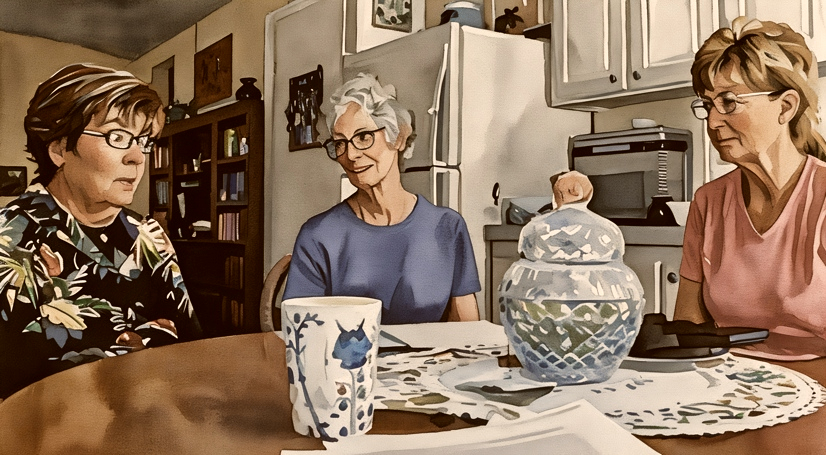
The moving truck arrived on Middle Street in Portsmouth a little after nine on a cold February morning. On the kitchen table inside the house sat the bill that made it necessary: $42 an hour for a caregiver—more than $13,000 for this month alone.
The woman who had lived there since 1982 had hoped to stay in that house for the rest of her life. Her daughter had gone through the figures the night before and arrived at the same conclusion she had been approaching for months. Even working extra shifts at Elliot Hospital in Manchester, she couldn’t make it work.
By noon the house would be empty, and the proceeds from its sale would pay the first year of assisted-living care.¹
The moment felt sudden.
But the real decision had been made years earlier—back when the family still had options.
When the first falls began, they might have built a small accessory apartment behind the daughter’s house in Manchester. The place she shared with her kids was just big enough for them, but a modest ADU in the backyard could have kept her mother nearby while she continued working.
Or they might have sold the Portsmouth house earlier and moved into a smaller single-floor place they could share.
At the time, none of that seemed necessary. The house still felt safe. The mother insisted she was doing fine. And selling a home that had carried forty years of birthdays, winters, and illnesses felt premature.
So the costs rose gradually.
A few hours of help each day quietly became a full daily shift. In New Hampshire, those hours now cost $45 to $50 each, and caregivers are scarce enough that families often take whomever they can find. Before long the monthly bill climbs into five figures, and the decision that once felt emotional begins to look unavoidable.²
Many families assume Medicare will prevent exactly this situation.
It doesn’t.
Medicare pays for hospital care, doctor visits, and short rehabilitation stays after illness or surgery. What it does not cover is the daily labor of getting older—bathing, dressing, cooking, and helping someone move safely through a house. Those tasks fall under what the system calls custodial care and sit largely outside Medicare.³
The system surrounding aging in America was built to treat illness, not the long stretch of ordinary life that follows it.
Once families encounter that gap, the house becomes the financial reserve. Savings thin out first, retirement accounts follow, and eventually the only asset large enough to sustain ongoing care is the house itself.
The numbers escalate quickly. At $39 to $45 an hour, eight hours of daily help runs roughly $9,500 to $11,000 a month. When care stretches to twelve hours a day—as often happens after another fall or the early stages of dementia—the annual cost can climb past $200,000. Few middle-class families can carry that for long.⁴
Across the country, versions of this scene unfold every day: a kitchen table, a stack of bills, and the quiet realization that the house has become the last financial lever left.
The difficult truth is that the most workable solutions usually appear earlier, when the need still seems distant. A small apartment behind a daughter’s house. A move to a single-floor home closer to family. Selling sooner while the owner still has the strength to shape the next stage of life.
Once you begin noticing the pattern, it appears everywhere.
Families wait because the house feels permanent, yet aging quietly turns time into a financial force. Each year that passes narrows the range of choices.
In Quebec, the picture often looks different. Provincial programs and tax credits offset a large share of the cost of home-support services, and many towns quietly encourage housing arrangements that keep older residents close to family. A modest single-floor home in the Eastern Townships can keep someone independent for years longer than a large two-story New England house designed for a young family.⁵
Across much of the developed world, aging rarely begins with the question of whether to sell the house. In countries such as the Netherlands, Denmark, and Sweden, municipal home-care teams provide subsidized help with bathing, meals, and supervision as needs grow.⁶ Japan reached a similar place through a national long-term care insurance program created in 2000 that helps cover home aides and assisted living without forcing families to exhaust their savings first.⁷ In much of the world, the daily labor of aging sits inside the health-care system. In the United States, it still falls largely on families—and often on the house itself.
Across Maine, New Hampshire, and Vermont, the houses themselves add another complication. Bedrooms sit upstairs. Bathrooms are narrow. Icy driveways and long distances to grocery stores turn ordinary errands into risks.
None of those details matter when the owners are forty.
They matter a great deal at eighty.
The shift often begins with a fall or a hospital stay. Soon discharge planners start asking about supervision, and the house that once symbolized independence begins to look like a safety risk. Families begin touring assisted-living facilities.
Some are comfortable and well run, but places like that often cost thousands of dollars each week. Others are cheaper and feel less like homes than institutions.
So families hold on to the house as long as they can.
Roughly three-quarters of Americans say they want to age at home. Yet the system surrounding those homes was never designed for it. American medicine treats emergencies brilliantly—heart attacks, strokes, broken hips—but the long years afterward, when someone simply needs help every day, fall into a gray space between housing and health care.
That gap is where houses quietly disappear.
Back on Middle Street, the movers closed the truck doors while the daughter helped her mother into the car’s passenger seat. From the sidewalk the old Portsmouth house looked exactly as it always had—the same porch railing, the same narrow staircase inside that had carried forty years of footsteps.
Homes protect us for a long time.
Eventually the arithmetic changes. The house that once felt like security becomes the asset that keeps everything else afloat.
From the sidewalk, the place on Middle Street looked unchanged.
But what looked like one family leaving a street was really the surface ripple of decisions made far beyond it.
⸻
Bibliography
1. Genworth Financial. Cost of Care Survey 2024. National survey documenting assisted-living and in-home care costs across the United States.
2. PHI National. Direct Care Workforce Data Center. Analysis of wages and workforce shortages among home-care aides in the United States.
3. Kaiser Family Foundation. Medicare and Long-Term Care Coverage. Overview of Medicare’s limits regarding custodial and long-term care services.
4. AARP Public Policy Institute. Valuing the Invaluable: Long-Term Care Costs and Family Caregiving. Research on financial impacts of long-term care on American families.
5. Gouvernement du Québec. Programme de soutien à domicile. Provincial programs and tax credits supporting aging at home in Quebec.
6. Organisation for Economic Co-operation and Development (OECD). Health at a Glance: Long-Term Care Across OECD Countries. Comparative analysis of home-care and elder-care systems across Europe.
7. Campbell, John C., and Naoki Ikegami. The Art of Balance in Health Policy: Maintaining Japan’s Low-Cost, Egalitarian System. Cambridge University Press; analysis of Japan’s national long-term care insurance program and home-support model.