The Rotten Dog
Politics
The Map, the Notice, and the Gate
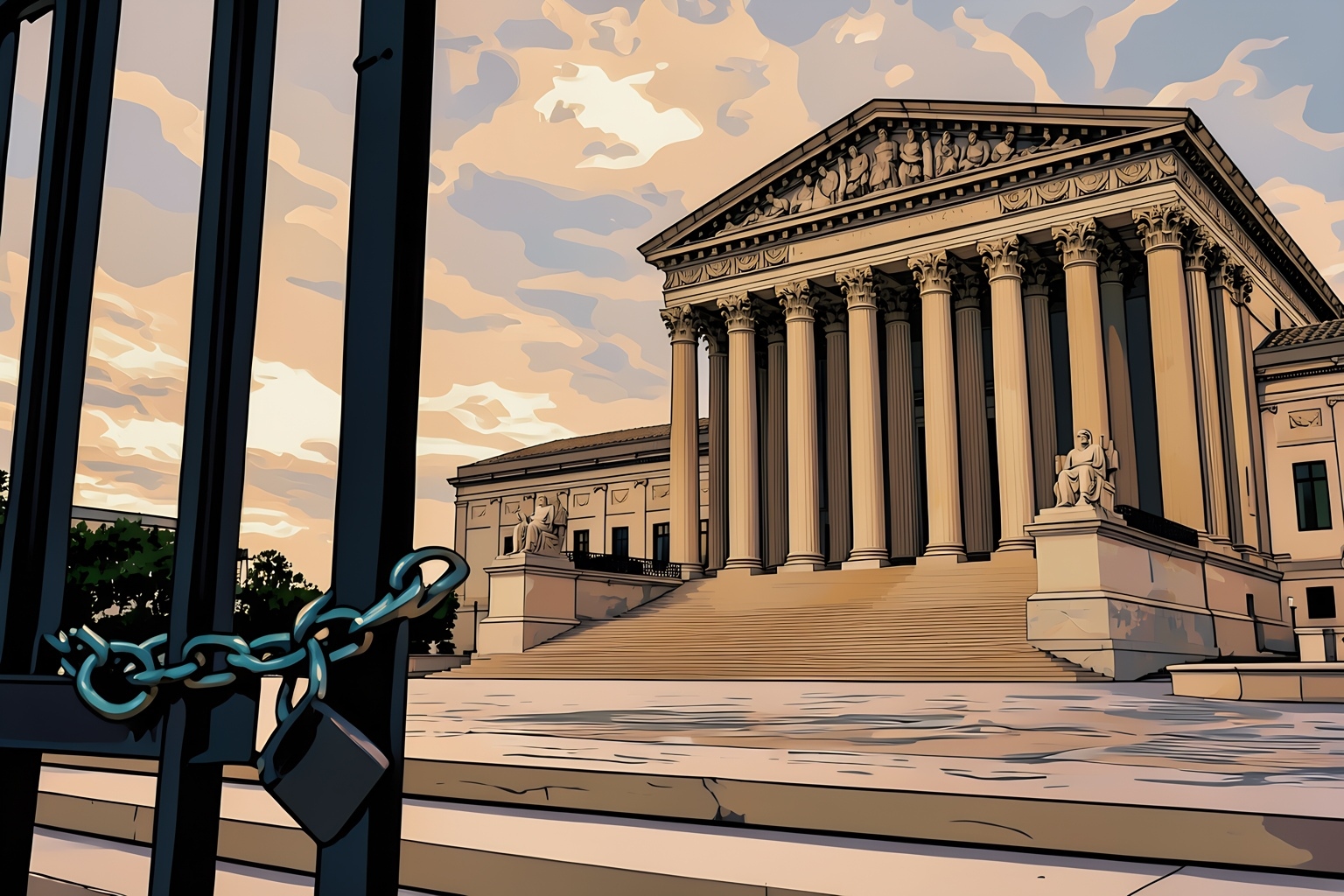
Rose-Thamar Joseph stood outside the Supreme Court with her phone in her hand. Inside, the justices were hearing whether Temporary Protected Status for Haitians and Syrians could be ended. Outside, another decision had already arrived: Louisiana’s second Black-majority congressional district was gone.¹
The same week brought another number: 10,000. Reuters reported that the administration had discussed adding 10,000 refugee slots for white South Africans, even as the overall refugee ceiling had been cut to 7,500.²
A map, a notice, a gate. Each had a legal explanation. Each moved through a different part of government. Each affected a different group. Put together, they made a pattern visible.
First came the map.
In Louisiana, Black residents make up about one-third of the state. After the 2020 census, the state’s congressional map gave them one district where they could reliably elect their preferred candidate. A lower court found that map likely violated Section 2 of the Voting Rights Act, so Louisiana drew another map, this time with two Black-majority districts.³
The Supreme Court said the second district went too far.
The Court did not say Black voters may not vote. It did not erase the Voting Rights Act from the statute books. It said the Voting Rights Act “did not require Louisiana to create an additional majority-minority district,” and without that requirement, the state had no compelling reason to use race the way it did in drawing the replacement map.⁴
That was the majority’s account. The case was not about weakening Black voting power, as told. It was about preventing the state from sorting citizens by race. Justice Samuel Alito framed the dispute as a constitutional limit on race-conscious districting, not as a retreat from the Voting Rights Act.⁵
Justice Elena Kagan saw the consequence differently. In dissent, she wrote that the decision leaves Section 2 “all but a dead letter.”⁶
A voter can keep their ballot even if they lose the their district.
That is the practical distinction behind much of voting-rights law. The Voting Rights Act was not written because America lacked promises. It was written because promises had been defeated by devices. The National Archives records the law’s formal purpose in its opening words: “To enforce the Fifteenth Amendment to the Constitution of the United States.”⁷
The Fifteenth Amendment was ratified in 1870, after a war that abolished slavery as a legal institution. It said the right to vote could not be denied or abridged “on account of race, color, or previous condition of servitude.”⁸
Then came the workarounds. Poll taxes did not always say Black. Literacy tests did not always say Black. Property rules, “good character” requirements, registration traps, and local discretion did not always say Black. They did not have to. The devices were often written in neutral terms and applied unequally.
The Voting Rights Act tried to stop that translation. It recognized that a voting rule could avoid racial language and still produce racial exclusion.
The Louisiana case sits inside that memory. The modern mapmaker does not have to stand at a courthouse door. The district line moves before the voter arrives. If Black voters are packed into one district or cracked across five, their ballots remain legal while their collective force is reduced.
Then came the notice.
Temporary Protected Status, or TPS, does not confer citizenship. It allows people from countries affected by war, disaster, or extraordinary conditions to live and work in the United States until the government determines that the protection is no longer necessary.⁹
The administration wants to terminate TPS for Haitians and Syrians. The case before the Court could affect far more than those two groups, because the legal question reaches the scope of executive discretion over temporary protection.¹⁰
Solicitor General D. John Sauer emphasized the first word in TPS. “Keep in mind, this is a temporary protected status,” he told the Court. “The word temporary is used again and again in the statute.”¹¹
That is the government’s point in plain form. The status was temporary. The secretary has discretion. Courts should not convert provisional protection into permanent residence, especially when Congress assigned the executive branch the task of evaluating changing conditions abroad.
Ahilan Arulanantham, arguing for Syrian TPS holders, emphasized the people underneath the word. “We’re talking about the power to mass expel people who have done nothing wrong to countries that remain unsafe,” he said.¹²
The notice does not say exile. It does not say removal by race. It says designation, termination, consultation, discretion, country conditions, and effective date.
For Afghans, the language has already done its work. A Federal Register notice terminating Afghanistan’s TPS designation said the decision became effective July 14, 2025. After that date, Afghans who had held TPS no longer had it unless another status protected them.¹³
For the person holding the paper, the legal vocabulary lands in ordinary places: a job, a lease, a driver’s license, a child’s school form, a church pew, a tax return. When status ends, the same life can become evidence of removability.
Haiti adds a visible contradiction. The State Department tells Americans, “Do Not Travel to Haiti” because of “crime, terrorism, kidnapping, unrest, and limited health care.”¹⁴ The administration, while warning its own citizens not to go there, is asking the Court to let it send Haitians back.
The legal issues are not identical to the voting case. In the Louisiana map case, the Court applied constitutional limits on race-conscious districting. In the TPS case, the government is seeking deference to its executive authority over immigration and foreign affairs. The doctrines differ.
The result for the affected people has a similar shape.
In redistricting, the injury is pushed toward partisan politics, where federal courts have already pulled back. In immigration, it is pushed toward foreign affairs and executive discretion, where deference has long been strongest. In both places, the visible consequence remains while the legal path to challenging it narrows.
Then came the gate.
While the administration pressed to end or narrow protection for Haitians, Syrians, Afghans, and other mostly nonwhite populations, Reuters reported that officials discussed adding 10,000 slots to a refugee ceiling already set at only 7,500, in order to admit more white South Africans.¹⁵
A separate Reuters report found that the government aimed to process 4,500 white South African refugee applications per month. A contracting document warned that failing to process that number “would result in failure to meet a Presidential priority.”¹⁶
South Africa rejected the premise behind the program. “The assertion that Afrikaners face systemic persecution is fundamentally unsubstantiated,” Foreign Ministry spokesperson Chrispin Phiri said.¹⁷
The refugee policy moved in the opposite direction from TPS. The ceiling went down. The South African priority went up. The group named in the reports was white South Africans. The South African government disputed the claim of systemic persecution.
Those facts do not make the legal questions the same. They do put them beside one another.
Black voters in Louisiana were told that a second Black-majority district could not stand because the state had used race too directly. Haitians and Syrians were told that protection was temporary and could be ended through executive judgment. White South Africans were identified for refugee priority inside a sharply reduced refugee system.
The map is not immigration law. The notice is not redistricting. The gate is not the Voting Rights Act. The cases were not the same. The movement was.
A district line determines which votes can be combined. A status notice decides whose life here remains lawful. A refugee ceiling decides whose claim of danger gets processed first.
America has always made such decisions through law. The Civil War was supposed to change who could be excluded from the answer. The Reconstruction Amendments tried to make Black citizenship irreversible. The Voting Rights Act tried to make that citizenship politically effective after a century of evasion. TPS, in a different register, recognized that some people already living here could not safely be sent back simply because their permission had an expiration date.
Now the expiration date is the point.
Rose-Thamar Joseph came to hear whether temporary protection could end. Black voters in Louisiana had already learned that a second district could not stand. White South Africans, according to Reuters, had become a refugee priority.
One line moved on a map. One date was moved on a notice. One gate opened in a smaller refugee system.
The country did not need to say what it was doing. The paperwork was enough.
Notes and Bibliography
Lindsay Whitehurst, “Supreme Court Mulls Trump Administration Push to End Protections for Migrants from Haiti and Syria,” Associated Press, April 29, 2026. Ted Hesson and Humeyra Pamuk, “Exclusive: Trump Poised to Expand Refugee Program for White South Africans,” Reuters, April 23, 2026. Louisiana v. Callais, No. 24-109, slip op. (U.S. Apr. 29, 2026); Amy Howe, “In Major Voting Rights Act Case, Supreme Court Strikes Down Redistricting Map Challenged as Racial Gerrymander,” SCOTUSblog, April 29, 2026. “Louisiana v. Callais,” SCOTUSblog, accessed April 30, 2026. Louisiana v. Callais, No. 24-109, slip op. Ellie Quinlan Houghtaling, “Elena Kagan Blasts Supreme Court Voting Rights Act Decision,” Ms. Magazine, April 29, 2026. National Archives, “Voting Rights Act (1965),” accessed April 30, 2026. National Archives, “15th Amendment to the U.S. Constitution: Voting Rights,” accessed April 30, 2026; National Archives, “Congress and the Voting Rights Act of 1965,” accessed April 30, 2026. “US Supreme Court Conservatives Seem to Favor Ending TPS for Haitians and Syrians,” The Guardian, April 29, 2026. Andrew Chung, “Supreme Court Leans Toward Trump’s Move Targeting Haitian and Syrian Immigrants,” Reuters, April 29, 2026; “US Supreme Court Hears Haiti, Syria TPS Case with Wide-Ranging Implications,” Al Jazeera, April 29, 2026. Justin Jouvenal and Ann E. Marimow, “Supreme Court Wrestles with Trump Effort to End Temporary Protections for Migrants,” Washington Post, April 29, 2026. Transcript of Oral Argument, Noem v. National TPS Alliance, No. 25-1083, U.S. Supreme Court, April 29, 2026. Department of Homeland Security, “Termination of the Designation of Afghanistan for Temporary Protected Status,” Federal Register, May 13, 2025. U.S. Department of State, “Haiti Travel Advisory,” April 16, 2026. Hesson and Pamuk, “Trump Poised to Expand Refugee Program for White South Africans.” Ted Hesson and Humeyra Pamuk, “Exclusive: U.S. Aims to Bring in 4,500 White South Africans per Month as Refugees, Document Says,” Reuters, February 26, 2026. Hesson and Pamuk, “U.S. Aims to Bring in 4,500 White South Africans per Month.”