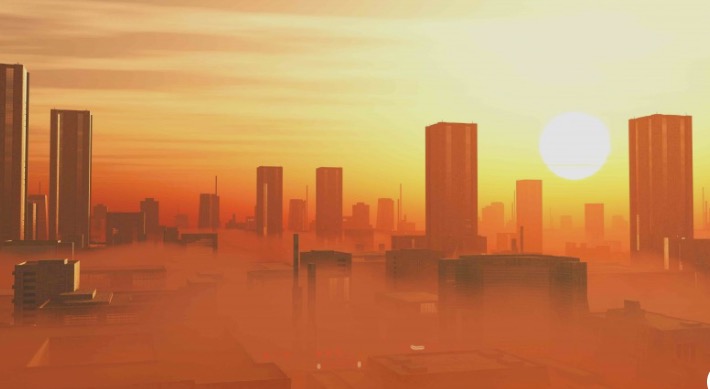
It seems very strange to think about urban heat killing people in July when the wind chill is in negative numbers. When pipes are freezing, when the news is full of stranded drivers and ice rescues, heat feels like a problem for another life, another season. But all of this ties together. The same destabilized climate system that delivers brutal cold snaps also delivers punishing summers¹. And in the United States, we have very deliberately reversed course on dealing with climate change. That decision is not abstract. It has consequences, and many of them arrive quietly.
The worst heat doesn’t announce itself. It doesn’t smash records or trigger emergency alerts. It doesn’t dominate the evening news. It just stays. In Roxbury, on a July night that should have cooled by ten degrees, the air hangs on like a grudge. Midnight comes. Then one a.m. The fan pushes warm air from one side of the room to the other. Asphalt gives back everything it absorbed during the day. Sleep becomes shallow, then impossible.
By morning, no one calls it a heat wave. But bodies remember.
This is how heat kills in American cities now—not with drama, but with duration. Climate change raises the baseline temperature². Cities trap it³. History decides who can escape it⁴.
Boston, New York City, and Washington, D.C. have spent the last decade discovering the same uncomfortable truth: heat is no longer a weather problem. It is an urban design problem layered on top of a warming climate, and it is getting worse faster than most people realize⁵.
The danger isn’t how hot it gets at noon. It’s how long the night refuses to cool.
Every city has two climates. One is measured at the airport, clean and official. The other lives between buildings, over parking lots, inside apartments that never quite cool down. That second climate is what scientists call the urban heat island, but the phrase understates the problem. It’s not an island. It’s a trap.
Concrete and asphalt soak up heat all day and release it slowly after sunset⁶. Trees that once cooled neighborhoods through shade and evaporation are missing, cut down decades ago to widen roads or squeeze in development⁷. Dark roofs bake. Narrow streets hold warmth like a thermos. Add humidity, and the body’s ability to cool itself begins to fail⁸.
Boston has begun to map this second climate, and the results are blunt. A small number of neighborhoods—Chinatown, Dorchester, East Boston, Mattapan, Roxbury—run consistently hotter than the rest of the city, sometimes by ten degrees or more⁹. These are not random locations. They line up almost perfectly with areas that were redlined, disinvested, and paved hard long before climate change entered public vocabulary¹⁰.
New York City sees the same pattern at scale. Heat-related deaths, estimated in the hundreds each year, are not evenly distributed¹¹. They cluster in neighborhoods where air conditioning is scarce, buildings are old, and nights stay hot long after the sun goes down¹². People don’t collapse dramatically in the street. They fail slowly, indoors, over days of accumulated stress.
Washington, D.C. once measured temperature differences of more than fifteen degrees inside its own borders¹³. Same city. Same day. Different survival odds.
In cities, heat is not democratic. It is zoned.
What’s striking is that cities already know how to reduce heat. The problem isn’t ignorance. It’s that the solutions look unimpressive compared with the scale of the threat.
Trees matter. Not symbolically, but physically. Streets with mature tree canopies are measurably cooler, especially at night, when retained heat does the most damage¹⁴. Planting trees evenly across a city looks fair and fails. Planting them aggressively where heat is worst saves lives.
So does tearing up asphalt where it serves no real purpose¹⁵. So do light-colored roofs that reflect sunlight instead of absorbing it¹⁶. So do shaded bus stops, cooler schoolyards, and apartments that don’t trap heat like ovens.
None of this is glamorous. All of it works.
Boston has started treating heat the way it treats a failing bridge or a leaking tunnel: as infrastructure failure¹⁷. Instead of asking how hot the city gets on average, planners ask how long people remain above dangerous temperatures. That shift—from peaks to exposure—changes everything. Cooling becomes a public health intervention rather than a lifestyle upgrade.
New York has learned the same lesson the hard way. Cooling centers help, but only if people can reach them and trust them¹⁸. Tenant protections matter more than press conferences. Retrofitting old apartment buildings is tedious, expensive, and far more effective than opening another temporary shelter¹⁹.
Washington, D.C. has learned to pay attention to humidity as much as temperature, because moisture is what pushes bodies over the edge²⁰. The city now drives heat sensors through neighborhoods to see where the danger really concentrates, block by block, rather than pretending the airport reading tells the whole story¹³.
Adaptation works when it is boring, targeted, and relentless.
All of this local effort sits on top of a larger problem cities did not create. Greenhouse gases have already locked in decades of warming²¹. That warming dominates the future of summer heat in the Northeast, regardless of what happens next²². At the same time, scientists expect large changes in Atlantic ocean circulation over the coming century, changes that may subtly reshape humidity and nighttime temperatures along the East Coast²³.
Here’s the part that matters for anyone not interested in model acronyms: none of this cancels the heat. At best, it rearranges it²⁴. In practice, it likely means fewer crisp summer nights and more sticky ones—the exact conditions that turn ordinary heat into a health crisis²⁵.
People don’t die from global average temperature. They die from nights that never cool.
Cities can cope. They cannot fix the upstream problem alone.
Right now, the United States is doing something deeply contradictory. We are asking cities to protect people from heat while national policy once again accelerates the forces making heat worse²⁶. Emissions rise. Standards weaken. Long-term planning is abandoned in favor of short-term politics. Then we express surprise when summers become lethal.
Cutting emissions is not an abstract environmental goal. It is health policy²⁷. Every additional degree of warming multiplies urban heat risks that no amount of tree planting can fully undo²⁸.
Heat also needs real federal money. It is already the deadliest weather hazard in the country, yet it remains underfunded compared with floods and hurricanes²⁹. Cooling infrastructure, building retrofits, urban forestry, and grid resilience should be funded like life-safety systems, because that is exactly what they are³⁰.
Housing policy has to stop fighting reality. Subsidizing inefficient, heat-trapping housing while asking cities to manage heat emergencies makes no sense³¹. Minimum thermal safety standards for rental housing, paired with financing to upgrade old buildings, would prevent more deaths than most emergency response programs combined³².
As long as heat is treated as weather instead of infrastructure failure, people will keep dying quietly.
Heat will keep arriving earlier. It will keep lingering longer. It will keep settling hardest in the same neighborhoods unless something changes.
The strategy is not mysterious. Cities know what to do. The country knows what to do too.
Success will not look like a graph bending gently downward.
It will look like a bedroom that finally cools after midnight.
⸻
Biibliography
1. Intergovernmental Panel on Climate Change, AR6 Working Group I (2021). Assessment of observed and projected climate system instability including extremes of heat and cold.
2. NOAA National Centers for Environmental Information, State of the Climate annual summaries. Documentation of rising baseline temperatures across the United States.
3. EPA, Urban Heat Island Basics (updated). Explanation of heat retention mechanisms in built environments.
4. Rothstein, Richard, The Color of Law (2017). Historical analysis of redlining and its lasting spatial and environmental effects.
5. City of Boston, Climate Ready Boston: Climate Projections Consensus (2016). Official projections guiding Boston’s climate adaptation planning.
6. Oke, T. R., “The Energetic Basis of the Urban Heat Island,” Quarterly Journal of the Royal Meteorological Society. Foundational physical explanation of urban heat retention.
7. Nowak, David J., et al., Urban Forest Effects on Climate (USFS). Quantification of tree canopy cooling effects.
8. CDC, Heat and Health Tracker. Explanation of humidity, heat index, and physiological stress.
9. Boston Foundation et al., B-COOL Heat Sensor Pilot (2024–2025). Neighborhood-scale temperature measurements in Boston.
10. Metropolitan Area Planning Council, Wicked Hot Boston. Mapping heat exposure against historical disinvestment patterns.
11. NYC Department of Health and Mental Hygiene, Heat-Related Mortality in New York City. Surveillance estimates of annual heat-related deaths.
12. Madrigano, Jaime et al., “Temperature, Housing, and Heat Mortality,” American Journal of Public Health. Analysis of housing quality and heat deaths.
13. The 51st, “Mapping Heat in Washington, D.C.” Reporting on intra-city heat differentials and sensor campaigns.
14. EPA, Using Trees and Vegetation to Reduce Heat Islands. Empirical evidence for nighttime cooling benefits.
15. City of Los Angeles, Cool Streets LA. Case study on depaving and surface cooling impacts.
16. Levinson, Ronnen et al., Cool Roofs and Urban Heat, Lawrence Berkeley National Laboratory. Performance of reflective roofing materials.
17. City of Boston, Heat Resilience Solutions. Framing heat as infrastructure and public health risk.
18. Klinenberg, Eric, Heat Wave (2002). Sociological study of access, trust, and cooling during extreme heat events.
19. ACEEE, Building Retrofits and Heat Resilience. Effectiveness of housing upgrades for thermal safety.
20. District of Columbia Department of Energy and Environment, Heat Emergency Plan (2022). Use of heat index thresholds in emergency response.
21. IPCC, AR6 Synthesis Report (2023). Carbon budget and committed warming analysis.
22. Massachusetts Executive Office of Energy and Environmental Affairs, Climate Change Projections. Regional heat projections for mid-century.
23. IPCC AR6 WG1 Chapter 9. Assessment of Atlantic Meridional Overturning Circulation weakening.
24. Ma, X., et al., “Revisiting Climate Impacts of an AMOC Slowdown,” Science Advances (2024). Modeling of AMOC effects on regional climate.
25. NOAA, Decades of Data on a Changing Atlantic Circulation (2024). Synthesis of Atlantic heat and humidity implications.
26. EPA regulatory rollbacks documentation (2017–2025). Federal policy changes affecting emissions trajectories.
27. Lancet Countdown, Health and Climate Change. Framing emissions reduction as public health intervention.
28. Hsiang, Solomon et al., “Estimating Climate Change Damages,” Science. Relationship between warming increments and mortality.
29. NOAA, Weather-Related Fatalities in the United States. Statistical comparison of heat versus other hazards.
30. FEMA, Building Resilient Infrastructure and Communities. Funding framework relevant to heat adaptation.
31. HUD, Housing Quality Standards. Limitations of current thermal safety requirements.
32. NASEM, Integrating Housing, Energy, and Health. Evidence-based recommendations for reducing heat mortality