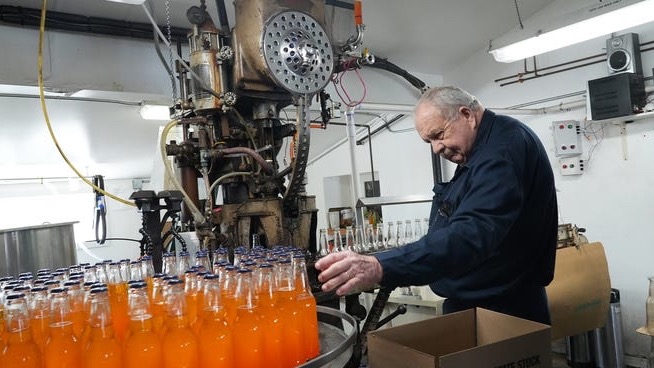
The machine doesn’t announce itself. It settles into the room.
There’s a rhythm to it—glass against metal, a soft release of gas, the almost polite click of caps sealing—that takes a minute to notice and then, once you do, becomes impossible to ignore. It isn’t loud enough to dominate the space, but it fills it completely, the way an old clock fills a quiet house. You realize, after a few minutes, that everything else in the room is adjusting itself around that sound.
Tom Conner stands beside the bottling line at Squamscot Old Fashioned Beverages and watches the bottles pass. He doesn’t hover. He doesn’t rush. He lets the machine run and then, every so often, makes a small correction—a touch here, a glance there—so slight you could miss it if you weren’t looking for it. The adjustments don’t interrupt the rhythm. They become part of it.
This is how the place works. Not through automation in the modern sense, but through a kind of practiced attention that keeps things aligned without ever quite calling attention to itself. You get the sense that the machine and the person running it have reached an agreement over time, each compensating for the other in ways that no manual could fully explain.
That agreement is what’s about to end.
After more than 160 years of continuous operation, Squamscot is being put up for sale. Tom and Eileen Conner are retiring. There is no one lined up to take their place—not because the business has collapsed or even because it’s struggling in any immediate sense, but because the long chain of continuation that sustained it has quietly run out of links.
The easiest way to misunderstand this story is to read it as decline. Nothing here looks like failure. The equipment works. The product sells. The name still carries weight in the small geography it has always served. If you walked in without knowing anything about it, you wouldn’t assume you were standing inside a business at the edge of its existence. You would assume you were standing inside something stable, something that had already proven it could last.
That’s precisely the point.
The company was founded in the mid-nineteenth century, when soda was still a local product and distribution was measured in miles rather than regions. It grew alongside Newfields, New Hampshire, not as a separate economic entity but as part of the town’s texture—one of those places that didn’t need to advertise its presence because it was already woven into the routines of the people who lived nearby. Generations passed through it, some as owners, some as workers, most simply as customers who knew what they were getting without needing to think about it.
What changed over time was not the business itself so much as everything surrounding it. The soda industry reorganized around scale, and then around distribution, and then around data. Shelf space became negotiated territory. Pricing became a function of volume. Production became less about making something and more about optimizing how it moved. None of those shifts required a company like Squamscot to disappear, but each one narrowed the space in which it could comfortably operate.
So the company adapted, though not in the way we usually celebrate. It didn’t pivot or reinvent itself. It held its ground. It continued to produce soda the way it always had, relying on a combination of habit, local loyalty, and the quiet advantage of being known. Over time, that position was recast—not as normal, but as distinctive. What had once been standard became “old-fashioned.” What had been common became “special.” The business didn’t change categories so much as the category moved around it.
That kind of survival depends on something that doesn’t show up on balance sheets: continuity of knowledge. Watching Tom Conner at the bottling line, you begin to see how much of the operation lives outside formal systems. He reads the machine the way a mechanic reads an engine by ear, registering slight variations in sound or timing that signal when something needs attention. He adjusts before problems become visible, keeping the process within a narrow band of “close enough” that experience has taught him is actually exact.
It is the kind of knowledge that accumulates slowly and disappears quickly.
When people talk about selling a business like this, they tend to focus on tangible assets—equipment, inventory, brand, real estate. Those are all real, and they all matter. But they are not the whole of what is being transferred. The more delicate question is whether the intangible parts of the operation—the feel of it, the judgment embedded in routine—can move with it.
In many cases, they don’t.
A new owner can purchase the line, the recipes, even the name, but still find that something essential has shifted because the work is being interpreted differently. The soda may taste the same for a while. The labels may look identical. Yet the underlying process, the subtle decisions that shape the outcome, begins to drift. Over time, the product becomes a version of itself—recognizable, but not quite anchored in the same way.
That possibility sits in the background of the sale, even if no one states it outright. What happens next is not just a matter of ownership but of translation. Can what has been done here, in this particular way, be carried forward by someone who did not grow into it?
The broader pattern suggests how difficult that can be.
Across New England, businesses like this are reaching similar moments. Owners who started in the 1970s or earlier are stepping back. Their children, raised in a different economy, often choose paths that don’t lead back into the family operation. The work itself—physical, repetitive, tied to narrow margins—competes with alternatives that are cleaner, more flexible, and, in many cases, more lucrative. The regulatory environment has also grown more complex, layering compliance requirements onto operations that were originally designed for a simpler time.
None of these pressures, on their own, is decisive. Together, they create a threshold.
When the person who holds the operation together decides to stop, there is no obvious next step. The business can be sold, but not easily replicated. It can be continued, but not without adaptation. It can be closed, but not without consequence.
And so the question becomes less about whether Squamscot survives and more about what form that survival might take.
A buyer might preserve the operation largely as it is, recognizing that its value lies precisely in its continuity. That outcome requires a particular kind of motivation—part economic, part cultural—and it tends to be rare, though not impossible. More commonly, the brand is separated from the place. Production moves elsewhere, scaled or streamlined to fit a different model, while the original identity is retained as a signal to customers rather than a description of process.
The final possibility is the simplest to execute and the hardest to measure: the business closes, the assets are dispersed, and the property finds a new use. Along the Seacoast, where land values have risen steadily, that option carries its own logic. The ground beneath a small factory can, in some cases, be worth more than the factory itself.
Each path resolves the immediate question—what to do with the business—but answers a different, quieter one about what is allowed to continue.
For a town like Newfields, New Hampshire, those answers are not abstract. Places accumulate meaning through repetition, through the steady presence of things that do not need to be reintroduced every few years. When one of those things disappears, the change is not always dramatic, but it is noticeable. A small piece of the town’s internal map no longer corresponds to anything in the world.
You can see that awareness forming even before anything has actually changed. People begin to talk about the place in the past tense while it is still operating. They remember details more sharply. They assign significance to things that, until recently, required none.
Inside the building, the machine continues its quiet work. Bottles move through the line. Caps settle into place. The rhythm holds, steady and familiar, as if it has no reason to do anything else.
For now, it doesn’t.
But the continuity that sustained it is no longer guaranteed. The next set of hands has not appeared. The knowledge that lives in small adjustments and practiced attention has not been formally handed off. The system still functions, but the chain that carries it forward has thinned to a single link.
That is how these things end—not with a break, but with a pause that no one steps in to fill.
At some point, the machine will stop, whether briefly for a transition or permanently for good. When it does, the room will feel different in a way that is hard to describe until you’ve experienced it—the absence of a sound you didn’t realize had become part of how the place defined itself.
And once that absence settles in, it tends to stay.