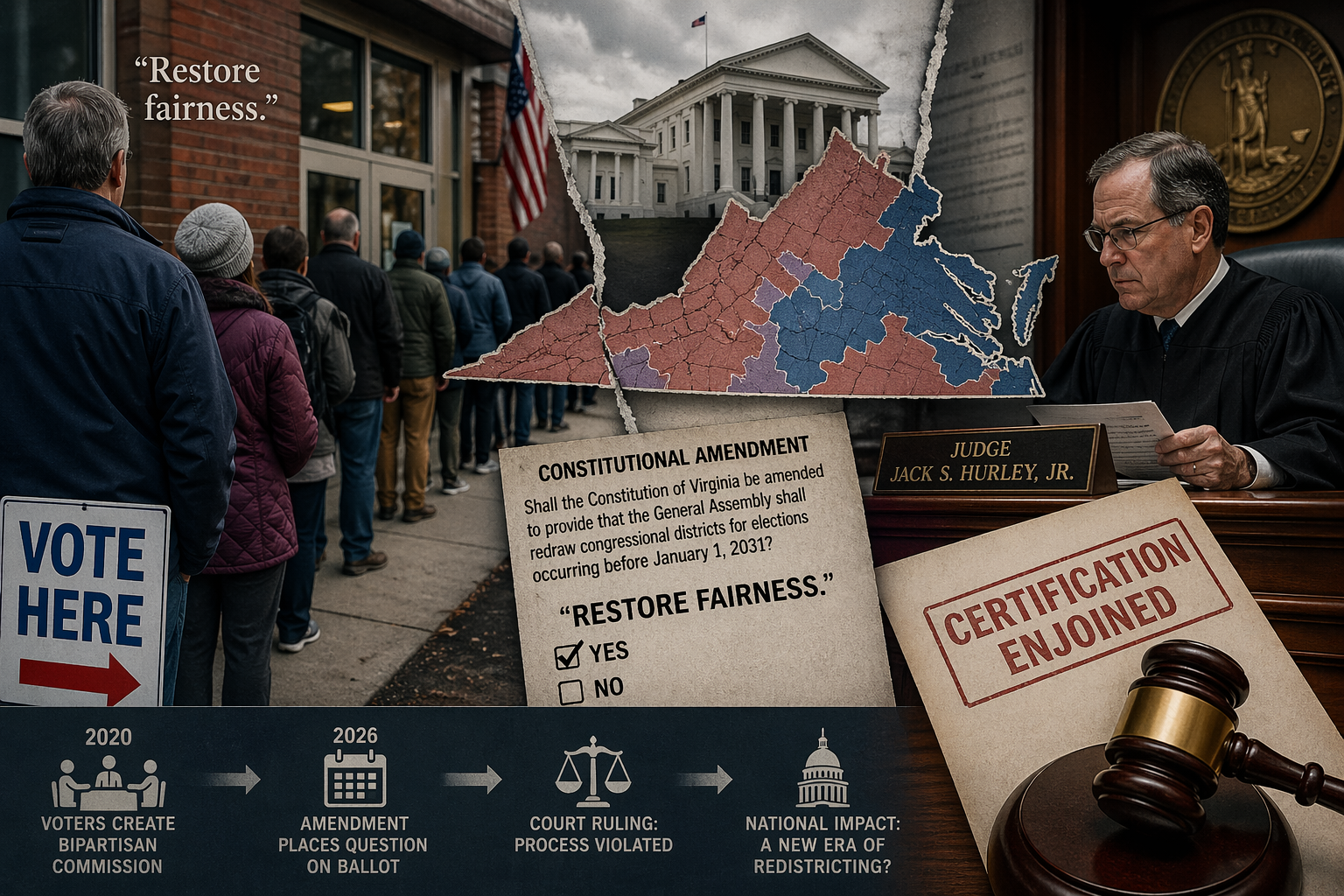
The line started before the doors opened, a loose arc of people holding coffee and folded sample ballots, shifting their weight against the chill as poll workers unlocked the glass entrance in Fairfax County. A man in a navy windbreaker—mid-50s, the kind of person who reads the ballot twice before filling it in—checked his phone again, not for news, but for the wording of the question he’d already read twice, the phrase that had been sticking with him since early voting began.
“Restore fairness.”
He said it quietly, not as a slogan but as a test, then stepped forward when the line moved.
What he was voting on had already been argued in court, dissected in legislative sessions, and sharpened into competing narratives, yet the underlying move was mechanical and precise: Virginia was trying to change when maps are drawn and who draws them. Timing and control, not ideology, were the levers, and once those levers shift, everything downstream begins to move with them.
Virginia had spent years trying to step away from that dynamic. In 2020, voters approved a constitutional amendment creating a bipartisan redistricting commission, splitting authority evenly between Democrats and Republicans so that neither side could unilaterally shape districts to its advantage. The system was intentionally rigid, tying map-drawing to the census cycle and locking those maps in place for a decade, which forced political competition to happen inside fixed boundaries rather than around them.¹
The new amendment, the one on the ballot that morning, temporarily suspended that arrangement. It would return map-drawing authority to the General Assembly for a defined period before handing it back after 2030, a narrow window aligned with the next few election cycles. Control would shift just long enough to matter, which is what made the change feel less like structural reform and more like a targeted extension of the cycle itself.
A woman two places behind him in line, bundled in a long gray coat, leaned toward a friend and spoke in the low, practical tone people use when they’ve already made their decision but still feel the need to justify it.
“We have to fight fire with fire.”
She wasn’t quoting a strategist. She was describing a system that had already started to move.
Across the country, redistricting had begun to loosen from its once-per-decade rhythm and take on a more flexible form, where advantage depends not only on how lines are drawn but on when they can be redrawn. In states like Texas and North Carolina, aggressive partisan maps had already reshaped congressional representation, and the gains from those maps were immediate and measurable in seats.³ That created a simple pressure: timing becomes part of the strategy, not just the outcome.
Virginia’s amendment didn’t introduce that pressure; it responded to it.
When the votes were counted, the margin was narrow but decisive, enough to move the amendment forward and open the door to a congressional map that could reshape representation within a single election cycle.⁴ For a brief moment, the result looked settled, the way election outcomes usually do once ballots are processed and numbers stabilize.
Then Judge Jack S. Hurley Jr. intervened, not to evaluate the map itself, but to examine the sequence that produced the question.
The Virginia Constitution requires amendments to move through a defined order—legislative approval, an intervening House election, approval again, and then submission to voters—which functions as a timing constraint. That structure forces proposed changes to pass through an election before reaching the ballot, limiting the ability of a single political moment to rewrite structural rules.⁵
Hurley concluded that constraint had been compressed. Early voting for the required election had already begun before one of the legislative steps was completed, placing the process inside the election it was meant to precede. He also cited the ballot language, where “restore fairness” framed the measure in a way that moved beyond neutral description.
Those findings stopped certification.
The response came from a different direction, anchored less in sequence than in scale.
“Voters’ voices should not be overridden…” — Jay Jones⁸
That argument treats the referendum as the decisive event, emphasizing participation and outcome over the procedural path that led there. Millions of voters answered the question as presented, and invalidating that answer reframes elections as conditional, particularly when the challenge comes after ballots have been cast and counted.
Supporters also note that the structural change was disclosed. The ballot described a temporary transfer of redistricting authority to the legislature before a return to the commission, which means the mechanism was visible even if the framing was not neutral.²
Opponents of the amendment locate legitimacy earlier in the process.
“The Constitution is clear, and the General Assembly ignored it.” — Jason Miyares⁹
In that view, early voting is not a prelude; it is part of the election itself. Once ballots are being cast, the constitutional sequence is no longer theoretical, and any step taken during that period collapses the separation the process is designed to enforce.
Governor Glenn Youngkin framed the same concern in structural terms, describing the effort as an attempt to “short-circuit the Constitution,” which shifts attention away from immediate outcomes and toward the durability of the rules that govern them.¹⁰
That divergence—outcome versus sequence—marks the point where the arguments separate.
One side measures legitimacy at the ballot box, where participation resolves the question. The other measures it in the architecture leading up to that moment, where adherence to process determines whether the question was valid to begin with.
What gives the case weight beyond Virginia is not the map it might produce, but the behavior it signals. If mid-decade redistricting becomes a repeatable response to perceived imbalance, the ten-year cycle stretches in practice, even if it remains fixed in law.
In a small set of unified-control states—where one party holds the legislature and can sustain a redraw through expected litigation—this logic would allow additional redraws before 2030, effectively converting a decennial system into a conditional one. The incentive shifts immediately: maps become instruments that can be recalibrated, timing becomes a strategic variable, and each adjustment invites another.
Back in Fairfax County, the man in the navy windbreaker fed his ballot into the machine and waited for the confirmation screen, watching for the brief pause that signals acceptance. He didn’t know whether the amendment would survive the courts, or how the arguments would resolve, but he understood that the question he had answered was not finished.
He had voted on a map.
The system was now deciding how often that map could change.
⸻
Bibliography