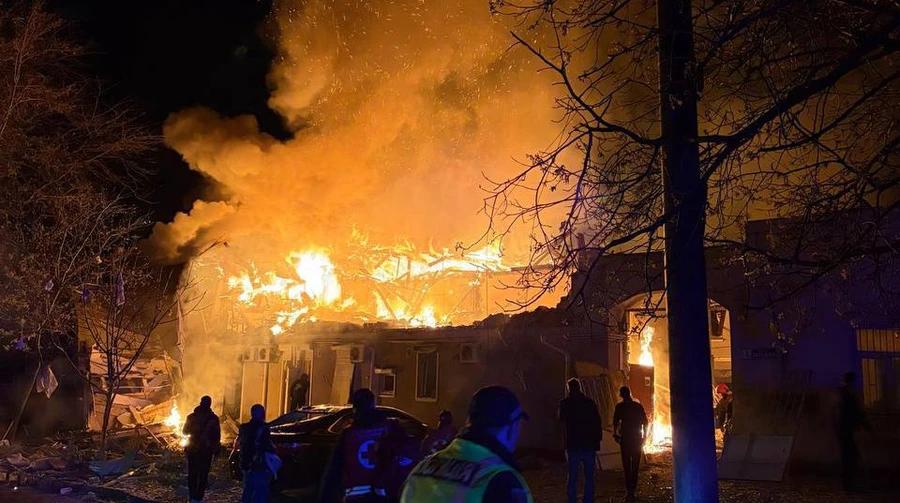
The message came in just after dawn.
“Two people died, 15 people were injured. Unfortunately, this is an ordinary night in Ukraine.”
Svetlanka in Kyiv sent it with a handful of photos—one of a street where glass had been swept into careful piles, another of a burned-out car still steaming in the morning air. In the background, people were already moving again, stepping around debris the way you step around puddles after rain.
It’s easy to miss this now. Ukraine has slipped out of the center of American attention, crowded out by louder, closer noise. The war did not slow when the coverage thinned. It changed shape.
Two nights earlier, another wave of drones crossed into Ukrainian airspace, part of a pattern that now repeats often enough to feel procedural rather than exceptional¹. The numbers vary—200, 300, sometimes more—but the structure is consistent: enough volume to saturate defenses, enough persistence to guarantee that some get through.
That is what Svetlanka meant by ordinary.
A few hundred miles east, in a half-burned warehouse outside Kostiantynivka, a Ukrainian operator leans over a tablet balanced on a crate, watching a thermal feed drift across a road that no longer carries traffic. A generator hums behind him, steady but never ignored. The system flags movement. He doesn’t look away.
War used to be about where you could move. Now it is about how fast you can decide.
That shift sits underneath everything happening along the 1,200-kilometer front, where Russia continues to press and Ukraine continues to hold, neither side breaking but both adjusting constantly. Ukraine’s commander, Oleksandr Syrskyi, said his forces retook roughly 50 square kilometers in March and about 480 since late January². The numbers would once have defined momentum. Now they measure interference—localized reversals inside a system that continues to apply pressure.
Russia is still attacking, still probing, still redistributing forces rather than committing to a single decisive thrust. Ukraine is no longer simply absorbing those blows. It is interrupting them, slowing them, sometimes reversing them. The map changes slowly. The decision cycle does not.
On the operator’s screen, the system assigns the target automatically based on proximity, available munitions, and prior tasking. DELTA aggregates the feeds—drone video, forward observers, electronic intercepts—into a single operational picture³. Target Hub reduces the decision path further by routing validated targets directly to units already in position, removing multiple layers of human approval⁴. In practice, that means fewer handoffs, fewer delays, fewer opportunities for a target to disappear.
The system identifies, sorts, assigns, and strikes—without pausing long enough for the target to slip away.
What used to require a chain of approvals now collapses into a sequence measured in seconds.
The operator watches as the drone feed sharpens. The vehicle resolves into shape, then into confirmation. By the time the system finalizes the target, the drone is already inbound.
And when the loop closes too slowly, the target simply isn’t there anymore.
The decision is no longer a moment. It is a process already in motion.
The mechanism is simple, and unforgiving. Whoever closes the loop faster controls the engagement.
Russia approaches the same problem from the opposite direction.
At facilities like Yelabuga, drone production has been scaled into industrial output, converting imported designs into a domestic supply measured in thousands per month⁵. But production is only part of the system. Russia has structured its drone warfare around layered pressure: long-range saturation strikes to overwhelm defenses, combined with tactical drone units operating closer to the line to extend reach and exploit exposed targets.
The result isn’t precision. It’s pressure—applied everywhere it can reach, for as long as it holds.
In recent weeks, salvos have climbed past 300 drones in a single attack, sometimes combined with missiles, extending over hours rather than minutes¹. The objective is not to guarantee hits on specific targets. It is to exhaust interception capacity, degrade infrastructure, and force a permanent defensive posture.
“They do not face shortages of platforms, and they are effective,” said Pavlo Rozlach of Ukraine’s 8th Air Assault Corps, describing Russian drone formations that now operate with greater coordination and depth.
One of those adaptations runs along a physical line rather than a signal.
Fiber-optic drones.
Instead of relying on radio control, these systems use a tethered fiber link, making them largely immune to electronic jamming. Early deployments were limited. Then they scaled quickly, appearing in coordinated groups, extending engagement ranges—but constrained by cable length and vulnerable to physical severing⁶.
The pattern is familiar. Ukraine innovates first. Russia absorbs the lesson, then deploys it at scale.
The operator glances at another feed. A Russian drone moves low, steady, following a path that cannot be easily disrupted. He shifts slightly, listening to the generator, to the distant, rhythmic thud of artillery that now blends into the background.
Ukraine still holds an advantage in integration.
Its drone ecosystem is broader and more adaptive, combining FPV strike drones, interceptor drones, maritime systems, and long-range platforms into a layered structure. Production has scaled rapidly, with tens of thousands of interceptor drones designed specifically to target incoming UAVs, turning air defense into a distributed, low-cost system rather than a purely missile-based one⁷.
At the same time, Ukraine has extended its reach into Russia itself, striking oil terminals, refineries, and logistics nodes. These are not symbolic attacks. Each strike forces repair cycles, redistributes resources, and imposes friction on the system behind the front line⁷.
Russia answers by maintaining contact everywhere.
Rather than concentrating forces for a single breakthrough, it probes continuously along the line, shifting pressure, reinforcing where resistance weakens, and sustaining assaults across multiple axes⁸. The approach trades speed for persistence, betting that enough localized pressure, applied long enough, will produce structural failure.
The trade remains stark. Russia buys pressure with mass and persistence. Ukraine buys time with coordination and speed.
Above it all runs a quieter contest that rarely appears in footage.
Connectivity.
Ukraine’s battlefield still depends heavily on Starlink, the network that allows units to coordinate across distances where traditional communications would fail⁹. Russia is building alternatives, launching low-orbit satellites, attempting to close that gap. The drone war is also a bandwidth war, a latency war, a contest over whether information arrives in time to matter.
A delay of seconds can mean a missed strike. A dropped connection can mean a lost position.
Back in Kyiv, Svetlanka was at work and on her second cup of coffee. The day was sunny, and flowers were starting to bloom. The routine holds, until it doesn’t—until a building is gone, or someone doesn’t answer a message.
In March, civilian casualties rose again, driven increasingly by drones that now reach beyond the front, into towns, markets, roads¹⁰. The boundary between battlefield and background has thinned to the point where it often disappears.
The operator in the warehouse leans back for a moment, then forward again as another alert appears. He does not think in kilometers. Those numbers come later. His war is measured in completed cycles—how quickly a signal becomes a decision, how often that decision arrives before the other side can respond.
Outside, the road remains empty.
What once moved along it—trucks, people, ordinary life—has been replaced by signals, patterns, fleeting signatures of heat. The war has not stalled. It has compressed, accelerated, turned space into time.
And somewhere between a message sent at dawn and a system alert that lasts less than a second, it keeps moving, faster than the story most people are still telling about it.
⸻
Bibliography